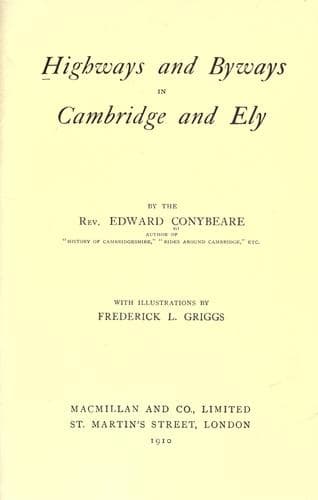
Highways and Byways in Cambridge and ElyConybeare, John William Edward
History
Highways and Byways in Cambridge and Ely
Conybeare, John William Edward
Cambridgeshire (England) -- Description and travel; Isle of Ely (England) -- Description and travel
Littleport is now quite a thriving and prosperous place, with a
shirt-factory employing over 300 hands and a most effective system of
agriculture in the reclaimed fens around. It has a fine Early English
church, and a grand tower, through the basement of which goes the
footway of the street. Until the nineteenth century the place was so
inaccessible by land that the Cambridgeshire annalist Carter (1752)
tells us that "it is as rare to see a coach at Littleport as a ship at
Newmarket."
From Littleport the road pursues its level way for seven miles across
the fen, till, after crossing the small islet of Hilgay, it strikes
the Norfolk uplands at their south-western corner, hard by Denver
Sluice; the present boundary of the North Sea tide, which once ran up
almost to Cambridge. This magnificent Sluice is the keystone of the
whole drainage scheme of the fenland. Here the New and the Old Bedford
Rivers, whose start we saw at Earith (p. 280), once more rejoin the
Ouse, having conveyed in twenty-two miles the waters which by the old
channel would have taken thirty-three. This, of course, gives them a
better fall, and renders them less liable to silt themselves up.
Practically the New River does all the work, very little water being
in the Old except what the tide brings up. It is a striking sight to
be on the Sluice at high water and gaze at the sea waves ridging up
this old river with force that seems illimitable. And yet not enough
pass in, before the ebb calls them back, ever (or hardly ever) to
reach Earith, as a glance at the channel there instantly shows. Still
more striking is it to be on the Sluice when the spring tides are on,
and see the sea on the north of the Sluice standing fifteen or twenty
feet higher than the fresh waters on the south. One realises what
widespread disaster would ensue if the Sluice were to give way. Small
wonder that during the Fenian dynamite scare of 1867 the place was
watched day and night by a guard of soldiers. The Sluice itself is a
massive dam of stonework; having a big lock with two sets of gates,
one against the stream of the river, the other against the tideway of
the sea, which reaches this point by a broad cut from the important
seaport of King's Lynn.
Public-domain text, read in full here on John Shaqi.
Reviews
Reviews
No reviews yet
Be the first to share your thoughts on this work.
Elsewhere in the archive
Join the Discussion
Join the discussion
Sign in to leave a comment or review.
Sign InorCreate an account