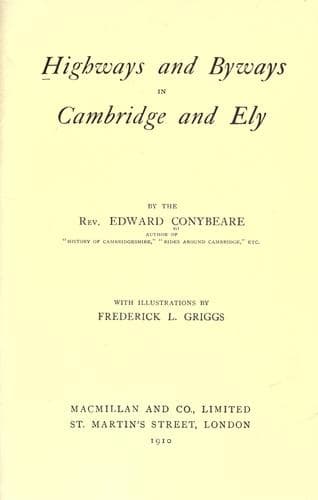
Highways and Byways in Cambridge and ElyConybeare, John William Edward
History
Highways and Byways in Cambridge and Ely
Conybeare, John William Edward
Cambridgeshire (England) -- Description and travel; Isle of Ely (England) -- Description and travel
"Assembling by sound of horn at Littleport, they sacked some of the
houses of the most prosperous, levied contributions on others, and
then marched on Ely in formidable force, armed with guns, pistols,
scythes, etc., and under cover of a waggon, on which they had mounted
four punt-guns. These formidable weapons, used for wild-fowl shooting,
with barrels eight feet long, whose charge was no less than a pound of
gunpowder, projected over the front of the vehicle to clear the way if
needful. But though the leading inhabitants of Ely had hastily armed
themselves, and been sworn in as special constables they were not
prepared to face this artillery, and the town passed without
resistance into the power of the mob, who repeated their Littleport
doings on a larger scale, though with little bodily hurt to anyone.
Unhappily the mob soon got out of hand, and the movement rapidly
degenerated into a mere drunken riot, the chief sufferers in which
were, as usual, those who had done most for the relief of the
poor--the local shopkeepers, who had aided them by credit, and the
local clergy, who had organised soup-kitchens for them.
"At the first approach of the military force sent for to suppress
them, the rioters retreated in good order, still under cover of their
armed waggon, to Littleport, where, however, only a handful made any
sort of stand when the soldiers actually arrived."[235] The rest
dispersed in panic, and not a blow was struck in defence of those,
some eighty in number, who were selected to be made an example of. A
special commission was held for the trial of these unhappy men. "In
spite of strong testimony to character, five were hanged, and five
more transported for life, the rest undergoing various terms of
imprisonment; all to the accompaniment of ecclesiastical rejoicings,
the Bishop entering the cathedral in solemn procession, to the strains
of the triumphal anthem, "Why do the heathen rage?", with his Sword
of State borne before him (by his butler!), and escorted by fifty of
the principal inhabitants, carrying white wands. No fewer than three
hundred of these wand-bearers guarded the execution of the five
rioters; yet the sympathy for them was so strong that the bishop could
not get a cart to carry them to the gallows under five guineas for the
trip."
[Footnote 235: From my _History of Cambridgeshire_.]
Such was the last serious exercise of the Bishop's long-descended
secular jurisdiction over the Isle. From the Girvian Princes to the
Abbesses of Ely, from the Abbesses to the Abbots, from the Abbots to
the Bishops that Palatinate jurisdiction had been handed on for twelve
hundred years;--and this was its sordid close. It died none too soon.
Public-domain text, read in full here on John Shaqi.
Reviews
Reviews
No reviews yet
Be the first to share your thoughts on this work.
Elsewhere in the archive
Join the Discussion
Join the discussion
Sign in to leave a comment or review.
Sign InorCreate an account