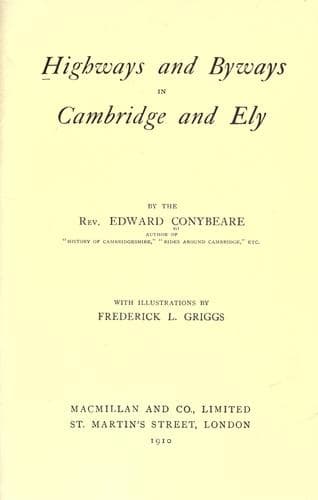
Highways and Byways in Cambridge and ElyConybeare, John William Edward
History
Highways and Byways in Cambridge and Ely
Conybeare, John William Edward
Cambridgeshire (England) -- Description and travel; Isle of Ely (England) -- Description and travel
The New Court, on its southern side, is separated by a traceried
cloister from the College Backs. On passing through the gate of this
it is well to bear to the left and walk along the bank of the river,
here overhung by magnificent elms, and affording a picturesque
prospect of the Trinity buildings on the other side. The grounds of
both Colleges to the west of the river are here divided up into a
series of lawn-tennis courts, and are parted from each other by a
broad ditch, which runs beneath the boughs of bowery horse-chestnut
trees. In spring the Trinity bank of this ditch is bright with
daffodils, the Johnian with narcissus. An iron foot-bridge, common to
both Colleges, with a gate at either end, gives access from one to the
other; but we had best continue by the path which skirts the Johnian
bank. This finally leads out of the College grounds into the Backs
proper, by a fine iron gate bearing a gilded eagle rising from a
crown, the crest borne by Lady Margaret.
Before we reach this, we find water on either side of us; that to the
west being not from the Cam, but a small tributary brooklet which
joins the river near the Great Bridge. It is here dammed up so as to
afford space for the College swans to make merry in, and on the
further side is the Fellows' Garden, known as "the Wilderness." The
wealth of spring flowers here cultivated--snowdrops, daffodils,
crocuses, primroses, anemones, and hyacinths--is delicious in a
country like Cambridgeshire, where Nature supplies their charms with
very niggardly hand in comparison with the more favoured regions of
England. Outside the Eagle gate we are close to the entrance of the
Trinity avenue.
Let us stand once more before the great gate of Trinity. Turning to
the south, instead of the north as before, we find ourselves in a few
score yards with the buildings of a College again to the east and west
of the street at once. This College is commonly known as Caius
(pronounced Keys), and officially as "Gonville and Caius," after the
original founder in the fourteenth century, and the benefactor who,
two hundred years later, so largely developed it as to leave his name
also attached to the site.[69] The former was a simple parish priest,
rector of Terrington, on the Norfolk seaboard of the Wash. His little
college, designated the "College of the Annunciation,"[70] and
consisting only of a Master and three Fellows, found its original
quarters hard by Pembroke, with which it was founded simultaneously in
1347. A few years later, on Gonville's death, his friend and diocesan,
Bishop Bateman of Norwich, moved it to its present site, next door to
his own new college, Trinity Hall.
Public-domain text, read in full here on John Shaqi.
Reviews
Reviews
No reviews yet
Be the first to share your thoughts on this work.
Elsewhere in the archive
Join the Discussion
Join the discussion
Sign in to leave a comment or review.
Sign InorCreate an account