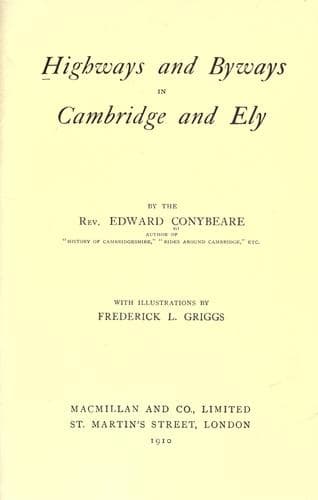
Highways and Byways in Cambridge and ElyConybeare, John William Edward
History
Highways and Byways in Cambridge and Ely
Conybeare, John William Edward
Cambridgeshire (England) -- Description and travel; Isle of Ely (England) -- Description and travel
[Footnote 69: The two infant cherubs which (without any heraldic
authority) act as supporters to the College Shield over the gate of
the new buildings (those to the east of the street) are popularly
supposed to be meant for the innocent souls of the two Founders. The
shield itself (duly granted by the Heralds' College, 1575), comprises
both their Coats with a blue and silver bordure. That of Dr. Caius is
curious; two green serpents standing on their tails upon a green stone
amid flowers of amaranth. This is declared (in the grant) to signify
"Wisdom stayed upon Virtue and adorned with Immortality"--a
characteristic Elizabethan "conceit."]
[Footnote 70: It was not till after Gonville's death that it began to
be called by his name.]
There Gonville Hall, as it was now called, gradually developed, but
remained a very puny bantling till the reign of Queen Mary, when one
of its own scholars took upon himself the task of expanding it. His
name was really Keys, which according to the fashion of the day, was
transliterated into the Latin equivalent Caius, and he was a
celebrated doctor of medicine, President of the College of Physicians,
and himself physician to the Royal household. It was in the interests
of his favourite study that he refounded the college, which to this
day has a specially medical tinge. He was also a singularly devout
man, and the spirit in which he built is exemplified by the three
gates through which we successively pass in our progress through the
College. From Trinity-street we enter beneath a narrow, plain,
low-browed archway, known as the Gate of Humility, and inscribed
HUMILITATIS.[71] A short avenue of lime-trees (also a part of the
Founder's design) leads across the small court to a loftier, wider
portal, over which we may read the word VIRTUTIS. Through this we gain
another court, and, looking back, we discover that in using the Gate
of Virtue we have indeed used the Gate of Wisdom; for it bears the
inscription IO. CAIVS. POSVIT. SAPIENTIAE. And, finally, a small,
beautifully designed turret, rich with Renaissance figures and
pilasters, and inscribed HONORIS, covers our exit through the Gate of
Honour, to which those of Humility, Virtue, and Wisdom have
successively led us on.
[Footnote 71: The present gateway is not, however, the original one,
but erected in mid-Victorian days at the same time as the large
pinnacled gate at the south-east corner of the College, but the humble
character of the original is fairly reproduced.]
Public-domain text, read in full here on John Shaqi.
Reviews
Reviews
No reviews yet
Be the first to share your thoughts on this work.
Elsewhere in the archive
Join the Discussion
Join the discussion
Sign in to leave a comment or review.
Sign InorCreate an account