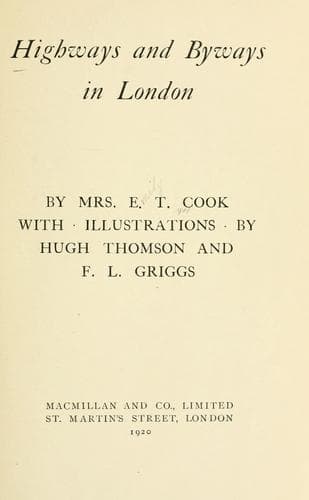
Highways and Byways in LondonCook, Emily Constance Baird
History
Highways and Byways in London
Cook, Emily Constance Baird
London (England) -- Description and travel
A few of the great monastic foundations of London escaped Henry
VIII.'s acquisitive zeal, and have, as modern school-boys have reason
to know, been devoted to educational and other charitable aims. It
was, indeed, eminently suitable that in the classic precincts of the
ruined monastery of the "Grey Friars" should arise a great school--the
School of Christ's Hospital (colloquially termed the "Blue-Coat
School")--where, till but the other day, the "young barbarians" might
be seen at play behind their iron barriers, backed by the fine old
whitely-gleaming, buttressed hall that faces Newgate Street. It was
fitting, too, that the early dwelling of the English Carthusian
monks--the place where Prior Houghton, with all the staunchness of his
race, met death rather than cede to the tyrant one jot of his ancient
right--should become not only a great educational foundation, but also
a shelter for the aged and the poor. We know it as the "Charterhouse";
as a picturesque, rambling building of sobered red-brick, built around
many courtyards, its principal entrance under an archway that faces
the quiet Charterhouse Square. The place has a monastic atmosphere
still; to those, at least, who reverently tread its closes and
byways--byways hallowed yet more by inevitable association with the
sacred shade of Thomas Newcome; shadow of a shade, indeed! fiction
stronger, and more enduring, than reality!
Yet the Charterhouse is, so to speak, an "insula" by itself in London,
a world of its own; possessing an ancient sanctity undisturbed by the
neighbouring din of busy Smithfield, the unending bustle of the great
city. More essentially of London is the curious unexpectedness of
buildings, places, and associations. What is so strange to the
inexperienced wanderer among London byways is the manner in which bits
of ancient garden, fragments of old, forgotten churchyards, isolated
towers of destroyed churches, deserted closes, courts and slums of
wild dirt and no less wild picturesqueness, suddenly confront the
pedestrian, recalling incongruous ideas, and historical associations
puzzling in their very wealth of entangled detail. The "layers" left
by succeeding eras are thinly divided; and the study of London's
history is as difficult to the neophyte as that of the successive
"layers" of the Roman Forum.
[Illustration: _The Shoeblack._]
Public-domain text, read in full here on John Shaqi.
Reviews
Reviews
No reviews yet
Be the first to share your thoughts on this work.
Join the Discussion
Join the discussion
Sign in to leave a comment or review.
Sign InorCreate an account