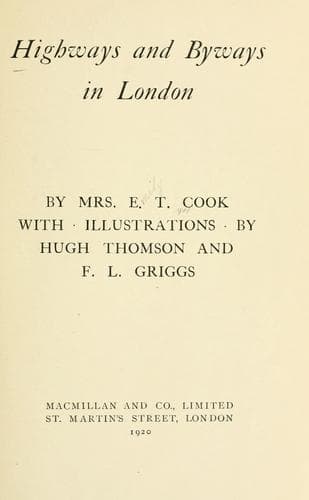
Highways and Byways in LondonCook, Emily Constance Baird
History
Highways and Byways in London
Cook, Emily Constance Baird
London (England) -- Description and travel
The "Surrey Side" is noted for its hospitals, as well as its prisons
and its slums; and of these "Guy's Hospital," on the left of the
Borough High Street,--an eighteenth-century foundation, due to the
wealth of a Lombard Street bookseller named Thomas Guy,--is one of the
most important. This Guy was in his way a miser, and his savings were
vastly increased by dealings in South Sea stock,--showing that some
good, at any rate, was wrought by the terrible "Bubble" that ruined so
many thousands. Yet the hospital narrowly escaped losing the rich
man's bequest. He was on the point of marrying his pretty maid, Sally,
when, his bride offending him by officious interference, he broke off
the marriage, and endowed the present hospital with his great wealth.
A blackened brass statue of the founder stands in the courtyard of the
edifice.
If Chaucer, with his ever memorable _Canterbury Pilgrims_, did much to
immortalise the Southwark of mediæval times, Dickens, the child of a
later era, has done at least as much for the Southwark of his day. In
the Borough High Street, close to the site of the demolished
Marshalsea Prison, stands St. George's Church, chiefly remarkable for
the fact that Dickens has here placed the marriage of his heroine,
"Little Dorrit," the Child of the Marshalsea. This was always a
district of prisons; the natural sequence, one would think, of
Southwark merry-making. Of the two Marshalsea prisons established here
at different times, the earlier, nearer to London Bridge, was
abolished in 1849; the later, so graphically described by Dickens, was
not pulled down till 1887, after having been let for forty years as a
lodging for tramps and vagabonds. Relics of it are now hard to find.
Dickens, who knew it well as a boy, thus describes (in the preface to
_Little Dorrit_) his search for it in later life:
"I found the outer front courtyard metamorphosed into a
butter shop; and I then almost gave up every brick of the
jail for lost. Wandering, however, down a certain adjacent
'Angel Court, leading to Bermondsey,' I came to Marshalsea
Place, the houses in which I recognized, not only as the
great block of the former prison, but as preserving the
rooms that arose to my mind's eye when I became Little
Dorrit's biographer.... Whoever goes into Marshalsea Place,
turning out of Angel Court, leading to Bermondsey, will find
his feet on the very paving-stones of the extinct Marshalsea
jail; will see its narrow yard to the right and to the left,
very little altered if at all, except that the walls were
lowered when the place got free; will look upon the rooms in
which the debtors lived; will stand among the crowding
ghosts of many miserable years."
Public-domain text, read in full here on John Shaqi.
Reviews
Reviews
No reviews yet
Be the first to share your thoughts on this work.
Elsewhere in the archive
Join the Discussion
Join the discussion
Sign in to leave a comment or review.
Sign InorCreate an account