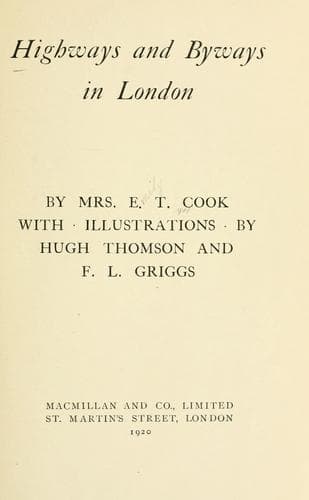
Highways and Byways in LondonCook, Emily Constance Baird
History
Highways and Byways in London
Cook, Emily Constance Baird
London (England) -- Description and travel
Dickens's boyish recollections of the ancient debtors prison have, as
was perhaps natural, sometimes more than a tinge of bitterness; here
he passed to and fro during wretched childish years, between the daily
drudgery of covering blacking pots at "Murdstone and Grinby's," down
by Hungerford Stairs. More wretched, indeed, far, than any modern
Borough waif, was this neglected and sensitive child of genius. The
intense torture of his degradation (as he thought it) was never wholly
forgotten. In this connection he tells (in Forster's _Life_) a
pathetic little story. No boy at the blacking office, it seems, knew
where or how he lived; and once, being taken ill there, and helped
towards home by a kindly fellow-worker, the child Dickens said
good-bye to his friend by Southwark Bridge:
"I was too proud" (he says) "to let him know about the
prison; and after making several efforts to get rid of him,
to all of which Bob Fagin in his goodness was deaf, shook
hands with him on the steps of a house near Southwark-bridge
on the Surrey side, making believe that I lived there. As a
finishing piece of reality in case of his looking back, I
knocked at the door, I recollect, and asked, when the woman
opened it, if that was Mr. Robert Fagin's house."
While the boy suffered thus acutely, his father lived on in a
Micawberish way at the Marshalsea, being merely of the amiable,
shiftless, idle genus that drags its family down. For the rest, they
did well enough at the Marshalsea: "The family," the son wrote, "lived
more comfortably in prison than they had done for a long time out of
it. They were waited on still by the maid-of-all-work from Bayham
Street, the orphan girl from Chatham workhouse, from whose sharp
little worldly, yet also kindly, ways I took my first impressions of
the "Marchioness" in _The Old Curiosity Shop_."
Yet Destiny works in strange and devious ways, and all the while, if
he had only known it, the Fates were conspiring for Charles Dickens's
good. It was the father's misfortunes that really taught the boy all
he needed to learn. Here, amid the unsavoury purlieus of the prison,
he unconsciously studied all the types and localities of which he was
to make such wonderful use in after-life. The Marshalsea and its ways;
Lant Street and Bob Sawyer; "Tip," "of the prison prisonous, and of
the streets streety"; Sam Weller at the "White Hart;" Nancy at London
Bridge Steps; Sikes and Folly Ditch; with a hundred others,--were,
more or less, to be the outcome of that time.
Public-domain text, read in full here on John Shaqi.
Reviews
Reviews
No reviews yet
Be the first to share your thoughts on this work.
Elsewhere in the archive
Join the Discussion
Join the discussion
Sign in to leave a comment or review.
Sign InorCreate an account