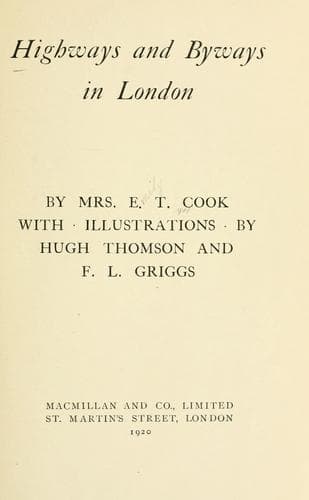
Highways and Byways in LondonCook, Emily Constance Baird
History
Highways and Byways in London
Cook, Emily Constance Baird
London (England) -- Description and travel
Charles Lamb, that "small, spare man in black,"--who, with his saddest
of life-histories, his patient devotion and fortitude, ill deserved
Carlyle's crude vituperation,--was a great devotee of the Inns, and
especially of the Temple, his birthplace. It was in Little Queen
Street, off Holborn, that the early tragedy happened that saddened all
his life; the murder of his mother by the hand of his dearly-loved
sister, in a fit of insanity. After this terrible occurrence, the
brother took his sister Mary into his charge, never after to part from
her, except only for her occasional necessary periods of restraint in
an asylum. In Colebrook Row, Islington, where Lamb retired on his
emancipation from the India Office, was the last abode of this devoted
couple; and here occurred the pathetic incident recorded by a friend,
that of the brother and sister walking across the fields towards the
safety of the neighbouring asylum, hand-in-hand, like two children,
and weeping bitterly.
[Illustration: _Pepys and his Wife._]
The Temple, so beloved of Charles Lamb, is the most widely known of
all the Inns; being the largest, and in some ways the most attractive.
Its garden-lawns slope gently and pleasantly towards the river; and
its quaint, time-honoured, and beautiful old squares have the added
charm of a long and romantic history. For here once was the stronghold
of the Knights Templars, that powerful fraternity, so masterful in the
picturesque Middle Ages; and, though the only substantial relic of
them that yet exists here is the old Temple Church, their memory still
lingers about these courts and gateways, adorned with their arms. And
Charles Lamb,--the real child of the Temple,--has, though born at a
later time, invested the place with a double charm. Born in 1775, in
Crown Office Row, his father servant to a Bencher of the Inner Temple,
the boy, from his earliest years, breathed in the poetry and romance
of his surroundings. Has not his touching description of a childhood
spent here almost the dignity of a classic?
"I was born" (he says), "and passed the first seven years of
my life, in the Temple. Its church, its halls, its gardens,
its fountain, its river, I had almost said--for in those
young years, what was this king of rivers to me but a stream
that watered our pleasant places?--these are my oldest
recollections.... What an antique air had the now almost
effaced sun-dials, with their moral inscriptions, seeming
coevals with that Time which they measured, and to take
their revelations of its flight immediately from heaven,
holding correspondence with the fountain of light! How would
the dark line steal imperceptibly on, watched by the eye of
childhood, eager to detect its movement, never catched, nice
as an evanescent cloud, or the first arrests of sleep!
"Ah, yet doth beauty, like a dial-hand,
Steal from his figure, and no pace perceived!"
Public-domain text, read in full here on John Shaqi.
Reviews
Reviews
No reviews yet
Be the first to share your thoughts on this work.
Elsewhere in the archive
Join the Discussion
Join the discussion
Sign in to leave a comment or review.
Sign InorCreate an account