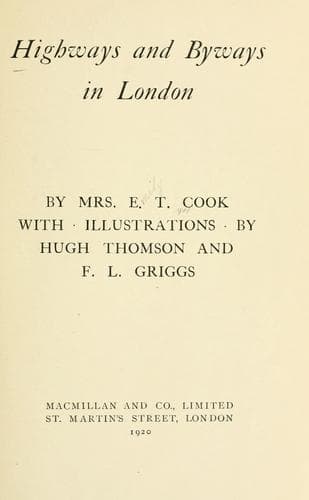
Highways and Byways in LondonCook, Emily Constance Baird
History
Highways and Byways in London
Cook, Emily Constance Baird
London (England) -- Description and travel
"I went astray" (he says) "in Holborn, through an arched
entrance, over which was 'Staple Inn' ... but in a court
opening inwards from this was a surrounding seclusion of
quiet dwelling houses, with beautiful green shrubbery and
grass-plots in the court, and a great many sunflowers in
full bloom.... There was ... not a quieter spot in England
than this. In all the hundreds of years since London was
built, it has not been able to sweep its roaring tide over
that little island of quiet."
And Dickens thus writes of it:
"Behind the most ancient part of Holborn, where certain
gabled houses some centuries of age still stand looking out
on the public way ... is a little nook composed of two
irregular quadrangles, called Staple Inn. It is one of those
nooks, the turning into which out of the clashing street
imparts to the relieved pedestrian the sensation of having
put cotton in his ears and velvet soles on his boots. It is
one of those nooks where a few smoky sparrows twitter in
smoky trees, as though they called to one another, 'Let us
play at country.'"
Dickens made this the abode of his kindly lawyer of _Edwin Drood_ (Mr.
Grewgious). The chambers where that gentleman is supposed to have
dwelt are marked on a stone above the doorway, with initials, and a
date--1747.
Beyond the first square, through another archway, a garden-plot is
reached, the garden of the Hall. Very picturesque is this old Hall,
long and low, with gabled lanthorns,--one large, one small,--and high
timber roofs. The garden plot is bright even in winter, with
variegated laurels and a privet hedge; these, with the darkened
red-brick of the old Hall, make a charming picture. Opposite the
garden-court extends the new and very attractive modern building of
1843, on a raised terrace: designed in early Jacobean style, and of a
simple dignity that does not quarrel with its surroundings. This line
of buildings is continued towards Chancery Lane by the new "Government
Patent Office," an admirable structure as yet untouched by the
mellowing London smoke. The buildings of the "Birkbeck Bank" opposite,
which, in their turn, tower over the little Staple Inn Hall and
garden, show,--in painful contrast both to their unobjectionable
Holborn front, and to the fine simplicity of the Patent Office,--a
very ornate medley of terra-cotta and Doulton-ware; a chaos of
bluish-green pillars and aggressive plaques and tiles, for which,
indeed, some covering of London soot is greatly to be wished. One
might almost think that one had got into Messrs. Spiers and Pond's
refreshment-rooms or a "Central-Railway-station" by mistake.
Disillusions, however, are frequent in this semi-chaotic region of new
and old buildings, and it must be confessed that the back of the
Patent Office (in "Quality Court") is somewhat disappointing after its
front view; it resembles, with its old, blackened pillars, a disused
Public-domain text, read in full here on John Shaqi.
Reviews
Reviews
No reviews yet
Be the first to share your thoughts on this work.
Elsewhere in the archive
Join the Discussion
Join the discussion
Sign in to leave a comment or review.
Sign InorCreate an account