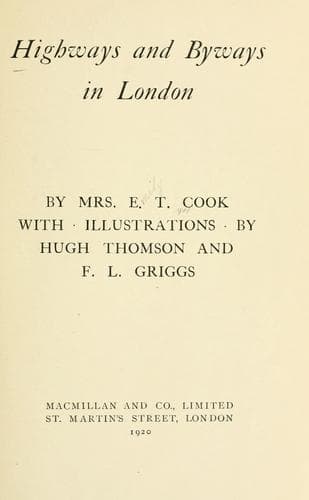
Highways and Byways in LondonCook, Emily Constance Baird
History
Highways and Byways in London
Cook, Emily Constance Baird
London (England) -- Description and travel
"To Newton and to Newton's Dog Diamond," says Carlyle, "what a
different pair of Universes; while the painting on the optical retina
of both was, most likely, the same." "A distinct Universe," adds
Thackeray in the same spirit, "walks about under your Hat, and under
mine." This latter reflection occurs to me often as I walk about
London, and note all its many "sorts and conditions" of men. There is
here, especially, everything in the "point of view." From the West to
the East is a wide difference; yet, between the two, how many minor
differences?
London, indeed, is hardly like a single city; it is rather like many
cities rolled into one. Here, more than anywhere else, you realize
that "it takes all sorts to make a world"; for the inhabitants vary
quite as widely as do those of foreign countries. It was Disraeli who
said, with much cynical truth:
"The courts of two cities do not so differ from one another
as the court and the city in their peculiar ways of life and
conversation. In short, the inhabitants of St. James's,
notwithstanding they live under the same laws, and speak the
same language, are a distinct people from those of
Cheapside."
[Illustration: _A Railway Bookstall._]
Between the people of the East, and those of the West, it is not
merely a question of distance; for, as a matter of fact, the two types
are often closely interwoven. Thus, there is an "East in the West,"
where, not infrequently, slums and mean streets lie in near
juxtaposition to squares of lordly pleasure-houses, and where recently
erected "model dwellings" for workmen flourish in the very hearts of
the Grosvenor and Cadogan Estates; and there is a "West in the East,"
as testified by the pleasant wide streets of comfortable roomy houses
that abound in the near suburbs of East and South London. Yet, it may
be broadly stated that every part of London has manners peculiar to
itself, as unvarying, in their way, as were the laws of the Medes and
Persians; with, also, one principal dividing-line,--that intangible
line separating the East End from the West End. Here are a few of the
differences between the two:
Public-domain text, read in full here on John Shaqi.
Reviews
Reviews
No reviews yet
Be the first to share your thoughts on this work.
Elsewhere in the archive
Join the Discussion
Join the discussion
Sign in to leave a comment or review.
Sign InorCreate an account