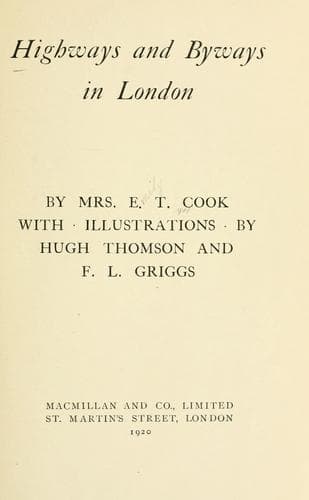
Highways and Byways in LondonCook, Emily Constance Baird
History
Highways and Byways in London
Cook, Emily Constance Baird
London (England) -- Description and travel
The West End has all the money and all the leisure; the East End
monopolizes most of the labour, and nearly all of the dirt. The West
End numbers a few thousands of floating population; the East End, a
million or so of pretty constant inhabitants. Yet, by some strange
association of ideas, it is to this small "West End" that we allude
when we speak of "all London," and to which the daily papers refer
when in August and September they assure us that "there is absolutely
no one left in town." The manners and customs of each are dissimilar;
both indulge in slang of a kind; but, while the East End usually cuts
off the initial letter of its words, the West-End drops the final one.
The West End is shocked by the East, but then, the East End is just as
much shocked, for its part, by the West. If the "lady" is full of
righteous scorn for the "factory hand" who spends her hard-won
earnings on a feathered hat and a plush cape, the slum-dweller is, on
the other hand, quite equally scandalized at the "lady's" brazen
boldness in wearing a _décolleté_ dress: "To think of 'er 'avin' the
fice ter go hout with them nyked showlders, 'ow 'orrid!" the factory
girl will say, from out the street-door crowd at an evening "crush."
Even a veiled Turkish lady, from the secluded harem, could hardly show
more genuine feeling at the unpleasant spectacle. No, our ways are not
as their ways. Their conventionalities are quite as strict, even
stricter, than ours. Possibly to them, even our speech sounds just as
faulty as theirs to us; probably they think us very ill-bred because
we do not constantly reiterate the words "Mrs. Smith," or "Mrs.
Jones," when addressing the said ladies; or cry immediately, "Granted,
Miss, or Sir," in reply to "I beg your pardon!" At any rate, we must,
to them, seem chilly and unresponsive. Then, the books we read, if
they understood them, would often greatly shock the slum-dwellers; the
pictures we hang in our parlours would horrify them. Servants do not
come from the slums or even from the lowest class; yet I have myself,
out of regard for their feelings, had to "sky" the most beautiful
_chefs-d'oeuvre_ of Titian, and turn the photograph of a masterpiece
by Praxiteles with its face ignominiously to the wall. And it's "'ow
you can go to that there National Gallery, 'm, and look at them
pictures of folkses without a rag on 'em, well, it beats me, it do
indeed!" After all, and once more, the difference is all in "the point
of view!"
[Illustration: _The City Train._]
Public-domain text, read in full here on John Shaqi.
Reviews
Reviews
No reviews yet
Be the first to share your thoughts on this work.
Elsewhere in the archive
Join the Discussion
Join the discussion
Sign in to leave a comment or review.
Sign InorCreate an account