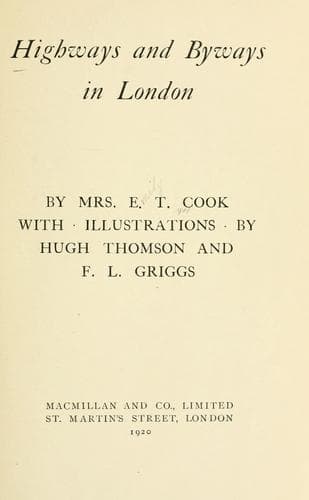
Highways and Byways in LondonCook, Emily Constance Baird
History
Highways and Byways in London
Cook, Emily Constance Baird
London (England) -- Description and travel
Nor is the "country,"--except in strictly limited quantities,--such an
unfailing consolation to the children of the poor, as some would have
us imagine. (That it is such a priceless advantage to their health is,
no doubt, partly owing to the fact that it is generally associated
with good and wholesome food.) The children like the "real country"
for a day or two;--afterwards, they are too often conscious of slight
boredom. At first, they delight in the fact that "it's so green all
rarnd,--right to the sky,--with no roads, and no walls,--and no
trespsin boards,--and no pleecemen;" but these joys have their
limitations,--and, after a fortnight's holiday,--even poor slum
children are generally glad to get back home. Even in tender
youth,--the country is a cult that requires some learning. "The
country is dreadful slow,"--a little girl of the great city once
remarked with painful frankness,--"no swings, no rahnd-abarts, no
penny-ice men, no orgins, no shops, no nothink;--jest a great bare
field only." Here, again, is the difference of "the point of view!"
Go into that glittering Armida-Palace, the busy Whitechapel Road, and
watch the scene at nightfall. The weather may be cold or mirk; the
weather matters little; the skies may be glum and starless, but a
galaxy of light, from innumerable gas jets and shop fronts, floods the
busy street. Here is, certainly, no lack of life and amusement; the
crowd laughs, jostles, and chatters, as if no such thing as care or
struggle existed. It is a motley crowd. Handsome dark-eyed Jewesses
with floppy hair and long gold earrings; coster girls "on the spree,"
dressed in their gaudy best; staid couples doing their weekly
marketing; here and there a happy family round a stall, eating
"winkles" composedly with the help of pins, or demolishing saucerfuls
of the savoury cockle; vendors of penny toys; all these, combined with
the voluble "patter" of the lively shop-boys, make a veritable
pandemonium. Shops are full; barrows of all kinds drive a brisk trade;
velvet-cushioned trams ply up and down the big highway, which extends,
apparently almost into infinity, up the long Mile End Road.
(Tram-lines, in London, seem more or less confined to the uninspiring
North and East and their suburbs.) Ugly and uninvigorating enough by
day, the streets, by night, invest themselves with mysterious glamour
and brightness. Like some murky theatre when the deceiving footlights
are lit, this, too, is a "stage illusion," and it is a wise one. For
all the East End does its shopping by gaslight; now only it begins to
enjoy its day. Seen in such kaleidoscopic glare of light, even the
Whitechapel Road has its attractions. Yet through it all one sometimes
sees sad sights. Many public-houses dot these thoroughfares, shining
like meteors through the nocturnal mists; and here and there, truth
to tell, a bevy of red-faced women may be seen through the
plate-glass, whose unhappy infants are stationed in shabby
Public-domain text, read in full here on John Shaqi.
Reviews
Reviews
No reviews yet
Be the first to share your thoughts on this work.
Elsewhere in the archive
Join the Discussion
Join the discussion
Sign in to leave a comment or review.
Sign InorCreate an account