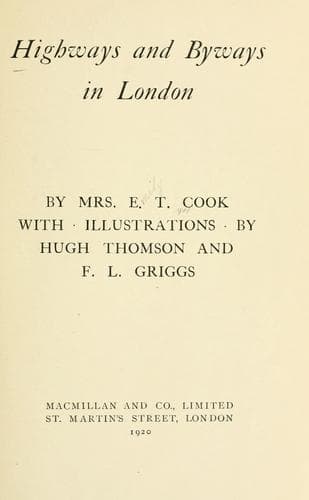
Highways and Byways in LondonCook, Emily Constance Baird
History
Highways and Byways in London
Cook, Emily Constance Baird
London (England) -- Description and travel
lands extending to the present Oxford Street, Fleet Street, and
Vauxhall."
Yet, without any of its former palatial accessories, is not the gray
fret-work of Henry VIIth's chapel, as it breaks on the delighted
vision of the traveller down Whitehall, an ever-renewed joy and
wonder? To Henry Tudor we owe the union of the houses of York and
Lancaster; yet we remember him far more by this, the chapel that he
has given us for all time. Truly, he too must have had "a rare taste
in building!" "It is to the exaltation of the building art," says Mr.
Ruskin, in an eloquent passage, "that we owe:
--"those vaulted gates ... those window-labyrinths of
twisted tracery and starry light; those misty masses of
multitudinous pinnacle and diademed tower; the only
witnesses, perhaps, that remain to us of the faith and fear
of nations. All else for which the builders sacrificed, has
passed away--all their living interests, and aims, and
achievements. We know not for what they laboured, and we see
no evidence of their reward. Victory, wealth, authority,
happiness--all have departed, though bought by many a bitter
sacrifice. But of them, and their life and their toil upon
the earth, one reward, one evidence, is left to us in those
gray heaps of deep-wrought stone. They have taken with them
to the grave their powers, their honours, and their errors;
but they have left us their adoration."
But, apart from the beauty of its architecture, apart from the
associations and traditions of its early history, apart from its
honour as the place of coronations, the feeling that every true
Englishman has for the Abbey of Westminster must necessarily be
strong; for it represents to him not only the essential spirit of his
mother-city; it is also, in a sense, his national Valhalla,
--"place of tombs,
Where lie the mighty bones of ancient men."--
Here, in this "cathedral close of Westminster," is his true
fatherland. This, he may say, is his national Holy of Holies; the
sacred spot:
"Wo meine Traüme wandeln gehn,
Wo meine Todten aufersteh'n."
Here he may feel all the reverence, all the love for his country, that
is ever the birthright of the true citizen. For, not only kings,
queens, and nobles, but also the great and mighty in art, science,
literature, are buried within this narrow space. It is England's
Temple of Fame, her crowing glory of a life of honour and merit. The
"immortal dead" are thus in their death brought near to each one of
us, and become part of our special family. They are our national
inheritance.
Public-domain text, read in full here on John Shaqi.
Reviews
Reviews
No reviews yet
Be the first to share your thoughts on this work.
Elsewhere in the archive
Join the Discussion
Join the discussion
Sign in to leave a comment or review.
Sign InorCreate an account