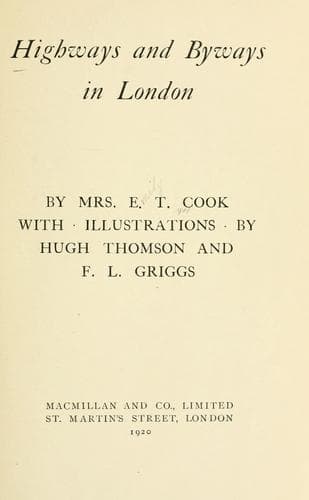
Highways and Byways in LondonCook, Emily Constance Baird
History
Highways and Byways in London
Cook, Emily Constance Baird
London (England) -- Description and travel
Westminster Abbey is "the silent meeting-place of the dead of eight
centuries," the "great temple of silence and reconciliation where the
enmities of twenty generations lie buried." Death is ever the great
peacemaker. Round the mediæval shrine of Edward the Confessor, in its
faded and rifled splendour, lie, in a closely-joined circle, the
peaceful Tombs of the Kings; sturdy Plantagenets, their warfare
ended, the features of their effigies composed in an eternal calm.
They sleep well, after life's fitful fever! In Henry VIIth's chapel,
Mary and Elizabeth, sisters of bitter hate and strange destiny, rest
together in a contracted sepulchre, admitting of none other occupant
but they two. "The sisters are at one; the daughter of Catherine of
Aragon and the daughter of Anne Boleyn repose in peace at last." On
their monument is the striking inscription: an inscription placed
there by James I.; "closing," said Dean Stanley, "the long war of the
English Reformation;" "Regno consortes et urnâ, hic obdormimus
Elizabetha et Maria sorores, in spe resurrectionis." And those great
statesmen of a later age, Pitt and Fox, their life-long rivalry ended,
rest in the north transept, dying in the same year, and buried close
together:
"Here--taming thought to human pride--
The mighty chiefs sleep side by side.
Drop upon Fox's grave the tear,
'Twill trickle to his rival's bier;
O'er Pitt's the mournful requiem sound,
And Fox's shall the notes rebound.
The solemn echo seems to cry--
'Here let their discord with them die.'"
The figure of William Pitt, Lord Chatham, in parliamentary robes, his
arm outstretched as if speaking, rises high above the surrounding
monuments:
"High over those venerable graves," says Macaulay, "towers
the stately monument of Chatham, and from above, his effigy,
graven by a cunning hand, seems still, with eagle face and
outstretched arm, to bid England be of good cheer, and to
hurl defiance at her foes."
In another splendid passage, Macaulay describes the later burial of
the son near the father:
"The grave of Pitt had been made near to the spot where his
great father lay, near also to the spot where his great
rival was soon to lie.... Wilberforce, who carried the
banner before the hearse, described the awful ceremony with
deep feeling. As the coffin descended into the earth, he
said, the eagle face of Chatham from above seemed to look
down with consternation into the dark house which was
receiving all that remained of so much power and glory."
"The silence of death," says Dean Stanley, "breathes here the lesson
which the tumult of life hardly suffered to be heard."
Public-domain text, read in full here on John Shaqi.
Reviews
Reviews
No reviews yet
Be the first to share your thoughts on this work.
Elsewhere in the archive
Join the Discussion
Join the discussion
Sign in to leave a comment or review.
Sign InorCreate an account