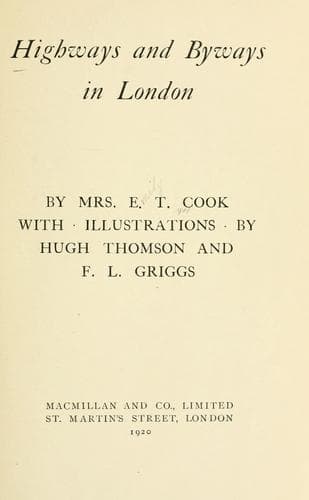
Highways and Byways in LondonCook, Emily Constance Baird
History
Highways and Byways in London
Cook, Emily Constance Baird
London (England) -- Description and travel
So far from being merely one town, London is really a hundred townlets
amalgamated. The visitor can there find everything that he wants; he
must, however, know exactly what it is that he wants to find. Does he
desire to see pictures? many galleries of priceless works of art are
within a stone's throw, free, ready, waiting only to be seen; does he
prefer realism and life? the "street markets" of Leather Lane and of
Goodge Street are instinct with all possible types of humanity; does
he yearn for peaceful solitude, historic association? the quiet nooks
of the Temple invite him; is it solitary study that his soul craves?
the immense library of the British Museum offers him all its
treasures; does he merely wish to perambulate vaguely? even the
prosaic Oxford Street presents a very kaleidoscope of human life.
Nevertheless, in his perambulations, the wanderer should receive a
word of warning: let him beware of asking for local information (save
indeed, it be of a policeman), for two reasons. Firstly, because no
born Londoner of the great middle class ever knows, except by the
merest accident, anything whatever about his near neighbourhood; and,
secondly, because if he do get an answer, he is morally certain to be
misdirected. The wanderer should always start on his expeditions with
a distinct plan in his own mind of the special itinerary he wishes to
adopt,--be that itinerary Mr. Hare's, or any other man's,--and he
should never allow himself to be drawn off from it to another tangent.
Even this crowded highway of Oxford Street, "stony-hearted
stepmother," old gallows-road, passing from Newgate Street to Tyburn
Tree, and bearing so many different names in its course,--beginning,
as "Holborn," in City stress and turmoil, intersecting the very centre
of fashion at the Marble Arch, and continuing as the "Uxbridge Road,"
to High Street, Notting Hill,--passes through all sorts and conditions
of men and things. Tottenham Court Road, that glaring, fatiguing
thoroughfare, which through all its phases ever "remains sordid,
sunlight serving to reveal no fresh beauties in it, nor gaslight to
glorify it," begins in comparative honour in New Oxford Street, to
descend through bustle and racket to the noisy taverns and purlieus of
the Euston Road. That sylvan village and manor of "Toten Court," where
city folk repaired in old days for "cakes and creame," seems far
enough away now! Fenchurch Street,--or rather its continuation Aldgate
Street,--as it merges into the long "Whitechapel Road," becomes more
and more dreary; not even its soft-gliding, cushioned tram-cars
lending enchantment to the depressing scene. Waterloo Road and
Blackfriars Road, "over the water," as they trend southwards pass
through strange and often unsavoury purlieus. Every district has its
special idiosyncrasies. Piccadilly and St. James's are always
aristocratic. Pall Mall has a severe and solid dignity; while the
Strand and its continuation, the narrow and tortuous Fleet Street, are
Public-domain text, read in full here on John Shaqi.
Reviews
Reviews
No reviews yet
Be the first to share your thoughts on this work.
Join the Discussion
Join the discussion
Sign in to leave a comment or review.
Sign InorCreate an account