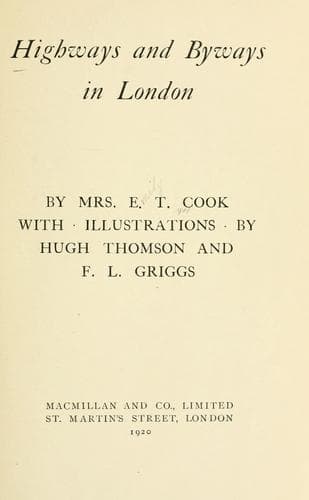
Highways and Byways in LondonCook, Emily Constance Baird
History
Highways and Byways in London
Cook, Emily Constance Baird
London (England) -- Description and travel
complete the royal circle.
Just in front of the screen that stands at the foot of the Confessor's
shrine, are the Coronation Chairs. The most battered and ancient of
these is the old coronation chair of Edward I, enclosing the famous
"Prophetic Stone" or "Stone of Destiny," of Scone; concerning which
the Scots believed, that wherever it was carried the supreme power
would go with it. Edward I. brought it from Scotland in 1297, in token
of the complete subjugation of that country. Every English monarch
since then has been crowned in this chair, and Queen Victoria used it
at her Jubilee service. The second coronation chair, (made for Queen
Mary II., wife of William III.), is only used when kings and queens
are crowned together: it was used for Queen Adelaide in 1831; and
lately for Queen Alexandra.
Opposite the wooden staircase that descends from the Confessor's
Chapel to the ambulatory below, a small doorway leads to the Islip
Chapel; where on "free" days, the "Wax Effigies" may be seen. This
curious and ghoul-like collection is the outcome of a custom dating
from ancient times; the custom of carrying in funeral procession,
first, the embalmed body open on the bier, and subsequently, the wax
effigy, or portrait model, for the crowd to gaze at; the effigy to
rest beside the tomb or monument. Remains of such effigies, broken,
mutilated and often unrecognisable, are extant even as far back as
Queen Philippa's time; these ghastly fragments are however, not on
general view. Eleven wax figures still remain; dirty, but in a
tolerable state of preservation; they suggest a very grimy and
antiquated Chamber of Horrors. Presumably taken from life, or, in
some cases, from a cast after death, they are invaluable as
contemporary likenesses. Charles II., an unpleasantly yellow, ogling
creature in wig and feathered hat, a ghoulish dandy with the
well-known "drop" in his cheeks, confronts us at the top of a narrow
wooden stair. If it be difficult to imagine his fascinations,--those
of his neighbour, "La Belle Stuart," are a trifle more suggestive; yet
here the lady is, surely, no longer very young; and we can hardly
connect her with the figure of "Britannia" on our pence, for which it
is said she consented to sit as model. Queen Anne's effigy (she died
at fifty) is, possibly, flattering; or it may be a more youthful
portrait. Her sad, pale face, in her gorgeous dress, suggest
remembrances of her eighteen dead children, buried in the Stuart Vault
of Henry VIIth's chapel, about the coffin of the Queen of Scots;
"pressing in and around, with their accumulated weight, the
illustrious dust below." Strange doom of the Stuart race! Were these
people merely human and not royal, would not such afflictions win our
sympathy? We hear of James II.'s faults--history is reticent about his
eleven dead children; of "Good Queen Anne's" virtues,--hardly a word
as to her maternal grief. Poor, kindly, amiable queen! as she sits
Public-domain text, read in full here on John Shaqi.
Reviews
Reviews
No reviews yet
Be the first to share your thoughts on this work.
Elsewhere in the archive
Join the Discussion
Join the discussion
Sign in to leave a comment or review.
Sign InorCreate an account