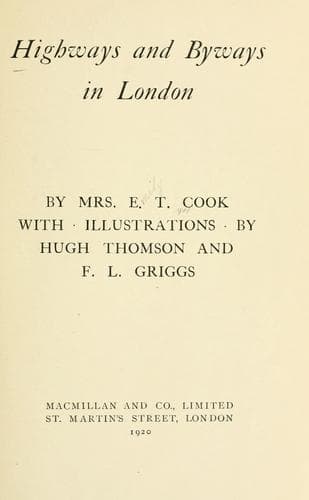
Highways and Byways in LondonCook, Emily Constance Baird
History
Highways and Byways in London
Cook, Emily Constance Baird
London (England) -- Description and travel
In one of the five small apsidal chapels at the eastern extremity of
the Abbey is Dean Stanley's fine monument, a recumbent figure, by
Boehm. Here, in the "farthest east" of the Abbey that they so loved
and lived in, he and his wife, Lady Augusta, "devoted servant of her
Queen," rest until the judgment day. The Duke of Buckingham's huge
tomb, that almost blocks another of these small chapels, is
picturesque: and near it, on the floor of the main building, is a blue
slab simply inscribed with the name of "Elizabeth Claypole." Close to
the great shrine of Henry and Elizabeth rests peacefully this
favourite daughter of Oliver Cromwell, the only member of her family
suffered to remain in the Abbey after the Restoration, when the
mouldering bodies of her father and his myrmidons were exhumed and
hanged at Tyburn, showing the furious brutality, unconquered even by
death, of the
--"foolish people, unsounde and ever untreue."
The "great Temple of Silence and Reconciliation," that had condoned so
many even greater wrongs, has, here alone, failed to protect its dead.
Henry VIIth's Chapel is now mainly used for such functions as the
yearly convocation of the bishops, and for early bi-weekly services
for the deanery and its precincts, &c. Its banners are decaying, its
stalls are no longer used by the "Knights of the Bath"; and the last
banner placed here was that of the Duke of Wellington, in 1804.
As Henry VIIth's Chapel is the mausoleum of the Tudors, so is Edward
the Confessor's Chapel that of the Plantagenets. Here the whole space,
indeed, is "paved with kings, queens, and princes, who all wished to
rest as near as possible to the miracle-working shrine." In the royal
ring of tombs, the treasure, the jewels, the gilt-bronze accessories,
and, in some cases, the arms and even the heads of the effigies have
been raided at some past time. The beautiful effigy of Eleanor of
Castile, wife of Edward I, that "queen of good memory" who accompanied
her lord to the Crusades, and in honour to whom nine monumental
crosses were erected in London, still, however, remains intact. "The
beautiful features of the dead queen are expressed in the most serene
quietude; her long hair waves from beneath the circlet on her brow."
Edward I, the greatest of the Plantagenets, lies near on a bare
altar-tomb of grey marble; a plain monument for so great and glorious
a being. On the north side are the words: "Scotorum Malleus" (the
Hammer of the Scots). At the head of Eleanor, his daughter-in-law,
lies Henry III., the "second founder" of the Abbey; "quiet Henry
III., our English Nestor," who reigned fifty-six years; his effigy is
of gilt brass. Katherine of Valois, widow of Henry V., the ancestress
of the Tudor line, rests under the altar of her husband's chantry; she
it was whose mummified corpse Pepys records that he kissed in 1668,
"reflecting upon it that I did kiss a queene." Queen Philippa of
Hainault, her husband Edward III., and the luckless Richard II.,
Public-domain text, read in full here on John Shaqi.
Reviews
Reviews
No reviews yet
Be the first to share your thoughts on this work.
Elsewhere in the archive
Join the Discussion
Join the discussion
Sign in to leave a comment or review.
Sign InorCreate an account