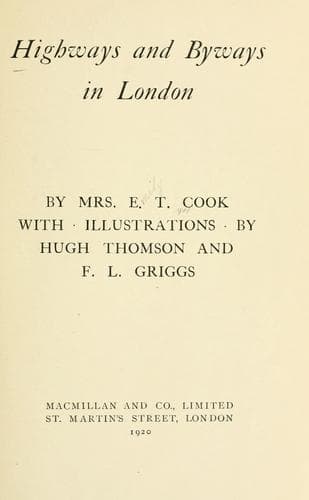
Highways and Byways in LondonCook, Emily Constance Baird
History
Highways and Byways in London
Cook, Emily Constance Baird
London (England) -- Description and travel
The great highway of Knightsbridge,--on the southern side of the
Park,--leads, as everybody knows, from Hyde Park Corner to Kensington.
Kensington, as it is now, is an all-embracing name, a generic term;
it comprises not only Old Kensington, but both "West Kensington," a
new and quickly increasing district of tall flats and "Queen Anne"
houses, as far removed from London proper, for all practical purposes,
as St. Albans; and "South Kensington," a dull and uninteresting
quarter, but close to all the big West-end museums and collections,
and where no self-respecting lady or gentleman of the professional or
"middle classes" can really help living. He, or she, must,
nevertheless, beware lest they stray too far from the sacred
precincts. For, on the west, South Kensington degenerates into Earl's
Court; on the south, a belt of "mean streets" divides it from equally
select Chelsea (and, in London, the difference of but one street may
divide the green enclosure of the elect from the dusty Sahara of the
vulgar); while on the east, its glories fade into the dull, unlovely
streets of Pimlico, brighten into the red-brick of the Cadogan
Estate, or solidify into the gloomy pomp of Belgravia.
These, however, are but Kensington's later excrescences, due to the
enormous increase of London's population, and to the consequent
building craze of the last century. It was the Great Exhibition of
1851 that gave building, in this direction, its great impetus. The
original village of Kensington, the "Old Court Suburb" of Leigh Hunt's
anecdotes, lies in and about the Kensington High Street, the Gardens,
and the Palace. It is pre-eminently of eighteenth century renown;
Pepys hardly mentions it; its glory was after his day. It is reached
from London by the Knightsbridge Road, a thoroughfare that, crowded as
it is to-day by the world of fashion, was, only at the end of the
eighteenth century, so lonely as to be unsafe from the ravages of
thieves and footpads; a road "along which," Mr. Hare remarks
plaintively, "London has been moving out of town for the last twenty
years, but has never succeeded in getting into the country." So
solitary, indeed, was this road that, even at the close of the
eighteenth century, a bell used to be rung on Sunday evenings to
summon the people returning to London from Kensington Village, and to
allow them to set out together under mutual protection. London is not,
even now, well lit as compared with large foreign cities; in old days,
however, the darkness was such as to draw down the well-deserved
strictures of Lady Mary Wortley Montagu. Such was the insecurity of
that courtly highway, the Kensington or Knightsbridge Road, that it
was the first place to adopt, in 1694, oil lamps with glazed lights,
in preference to the older fashion of lanterns and wicks of cotton.
Public-domain text, read in full here on John Shaqi.
Reviews
Reviews
No reviews yet
Be the first to share your thoughts on this work.
Elsewhere in the archive
Join the Discussion
Join the discussion
Sign in to leave a comment or review.
Sign InorCreate an account