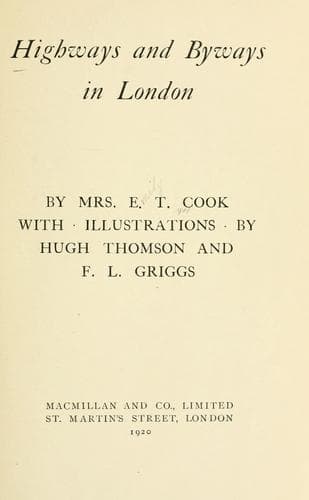
Highways and Byways in LondonCook, Emily Constance Baird
History
Highways and Byways in London
Cook, Emily Constance Baird
London (England) -- Description and travel
Some of London's finest mansions are now to be found in this
Knightsbridge Road. On the left, as you go towards Kensington, are
Kent House (Louisa, Lady Ashburton), once lived in by the Duke of
Kent, Queen Victoria's father; Stratheden House, and Alford
House,--this last a fine modern building of brick and terra-cotta,
with high roofs. Beyond Kensington Gore (so called from "Old Gore
House," that once occupied the site of the Albert Hall), is the
attractive and strangely rural-looking Lowther Lodge, now so cruelly
dominated by tall "mansions"; and further still, the vast "Albert
Hall," a red Colosseum of music. This, in spring, is a delightful
drive; indeed, London wears here such a semi-suburban air that it is
with almost the feeling of entering a new townlet that we presently
approach the charming "High Street" of Old Kensington. Charming it is
still, with still something of an old-world air; and yet, during the
last fifty years or so, it has terribly altered. In the old days, the
days when "the shabby tide of progress" had not yet spread to this
quiet old suburb of which Miss Thackeray wrote so lovingly;--had not
yet engulfed "one relic after another, carrying off many and many a
landmark and memory,"--there were "gardens, and trees, and great walls
along the high road that came from London, passing through the old
white turnpike.... In those days the lanes spread to Fulham, white
with blossom in spring, or golden with the yellow London sunsets that
blazed beyond the cabbage-fields.... There were high brown walls along
Kensington Gardens, reaching to the Palace Gate: elms spread their
shade and birds chirruped, and children played behind them."
Yet, even for sweet Dolly Vanborough, Miss Thackeray confesses, Old
Kensington was already vanishing. Already for her "the hawthorn bleeds
as it is laid low and is transformed year after year into iron
railings and areas, for particulars of which you are requested to
apply to the railway company, and to Mr. Taylor, the house-agent." How
much, alas, is left of it now? True, Holland House, and Kensington
Palace, and Gardens, are left inviolate, but Campden Hill is adorned
by the aspiring chimneys of waterworks, the peace of quiet Kensington
Square is invaded by model lodging-houses, the underground railway
defiles the pleasant High Street, and where of old the hawthorn
bloomed, tall placards now advertise "Very Desirable Mansions to be
Let on Exceptional Terms."
[Illustration: _Kensington Palace and the Round Pond._]
But Kensington has not changed in essentials. In those old days it was
already, as it is now, a great Roman Catholic quarter, with convents
and shops for the sale of sacred objects. No great cathedral had as
yet been built there; no Newman as yet looked steadfastly from his
marble alcove over the noisy Brompton Road; the tendencies in that
direction were, however, already paramount.
Public-domain text, read in full here on John Shaqi.
Reviews
Reviews
No reviews yet
Be the first to share your thoughts on this work.
Elsewhere in the archive
Join the Discussion
Join the discussion
Sign in to leave a comment or review.
Sign InorCreate an account