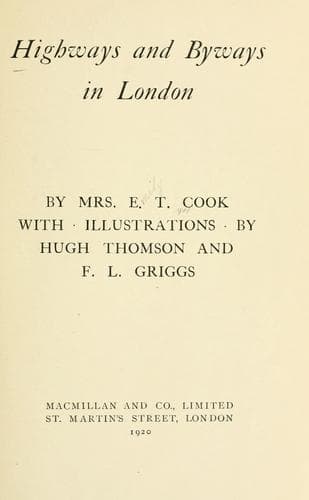
Highways and Byways in LondonCook, Emily Constance Baird
History
Highways and Byways in London
Cook, Emily Constance Baird
London (England) -- Description and travel
"Two days afterwards" (wrote Mr. Smith) "Leigh Hunt came in
a state of great agitation to tell me that his wife had
burned them. He had thrown the envelope with the banknotes
carelessly down, and his wife had flung it into the fire.
Leigh Hunt's agitation while on his way to bring this news
had not prevented him from purchasing on the road a little
statuette of Psyche, which he carried, without any paper
round it, in his hand. I told him I thought something might
be done in the matter. I sent to the bankers and got the
numbers of the notes, and then, in company with Leigh Hunt,
went off to the Bank of England. I explained our business,
and we were shown into a room where three old gentlemen were
sitting at tables. They kept us waiting some time, and Leigh
Hunt, who had meantime been staring all round the room, at
last got up, walked up to one of the staid officials, and
addressing him, said, in wondering tones: 'And this is the
Bank of England! And do you sit here all day, and never see
the green woods and the trees and flowers and the charming
country?' Then, in tones of remonstrance, he demanded: 'Are
you contented with such a life?' All this time he was
holding the little naked Psyche in one hand, and with his
long hair and flashing eyes made a surprising figure. I
fancy I can still see the astonished faces of the three
officials; they would have made a most delightful picture. I
said: 'Come away, Mr. Hunt, these gentlemen are very busy.'
I succeeded in carrying Leigh Hunt off, and, after entering
into certain formalities, we were told that the value of the
notes would be paid in twelve months. I gave Leigh Hunt the
money at once, and he went away rejoicing."
Opposite the Palace Gardens, where "Kensington Court" now stands,
stood once Kensington House, a big Roman Catholic boarding-house,
surely a kind of early prototype of the modern "mansions." Here
Louise de la Querouaille, Duchess of Portsmouth, lived, and here Mrs.
Inchbald died; later it was occupied by Jesuits, who have had for long
a special stronghold in this quarter. Then, at last, in 1876, the
older house made way for Mr. Albert Grant's pretentious Italian
mansion of the same name, which cost £270,000, and only existed seven
years, having been pulled down in 1883. So involved, and so difficult
to decipher, is the history of London buildings.
Public-domain text, read in full here on John Shaqi.
Reviews
Reviews
No reviews yet
Be the first to share your thoughts on this work.
Elsewhere in the archive
Join the Discussion
Join the discussion
Sign in to leave a comment or review.
Sign InorCreate an account