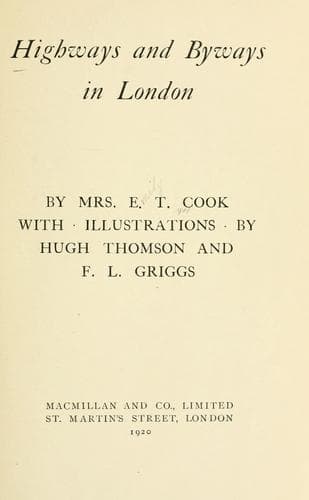
Highways and Byways in LondonCook, Emily Constance Baird
History
Highways and Byways in London
Cook, Emily Constance Baird
London (England) -- Description and travel
"Hunt's house" (he says) "excels all you have ever read
of--a poetical Tinkerdom, without parallel even in
literature. In his family room, where are a sickly large
wife and a whole school of well-conditioned wild children,
you will find half-a-dozen old rickety chairs gathered from
half-a-dozen different hucksters, and all seeming engaged,
and just pausing, in a violent hornpipe. On these and around
them, and over the dusty table and ragged carpet lie all
kinds of litter--books, papers, egg-shells, scissors, and,
last night when I was there, the torn heart of a
half-quartern loaf. His own room above stairs, into which
alone I strive to enter, he keeps cleaner. It has only two
chairs, a bookcase, and a writing-table; yet the noble Hunt
receives you in his Tinkerdom in the spirit of a king,
apologises for nothing, places you in the best seat, takes a
window-sill himself if there is no other, and then, folding
closer his loose-flowing 'muslin-cloud' of a printed
nightgown, in which he always writes, commences the
liveliest dialogue on philosophy and the prospects of man
(who is to be beyond measure happy yet); which again he will
courteously terminate the moment you are bound to go; a most
interesting, pitiable, lovable man, to be used kindly, but
with discretion."
In the neighbouring Cheyne Walk have, of course, lived many notable
people. Innumerable associations cling to this picturesque row of
time-darkened red-brick and white-casemented houses, with the graceful
wrought-iron railings and tall gates that shut out their trim
front-garden plots from the curious Embankment. At No. 4, died George
Eliot the novelist, in 1880, a short time after her marriage to Mr.
Cross. She had only recently settled into this charming London
dwelling, and her voluminous library had only just been arranged for
her with infinite care, "as nearly as possible in the same order as at
the Priory," when the sudden stroke of Death fell. Daniel Maclise, the
early-Victorian painter, a meteor of art, and the wonder of his own
age, had lived in this same house before. Cecil Lawson, that young
painter of such great promise, who died so early, lived at No. 15; and
No. 16, or "Queen's House," is bound up with the memory of that
brilliant and wayward genius, Dante Gabriel Rossetti, who lived here
after his wife's tragic death, and gathered round him his famous
miscellany of strange beasts and curious creatures.
Public-domain text, read in full here on John Shaqi.
Reviews
Reviews
No reviews yet
Be the first to share your thoughts on this work.
Elsewhere in the archive
Join the Discussion
Join the discussion
Sign in to leave a comment or review.
Sign InorCreate an account