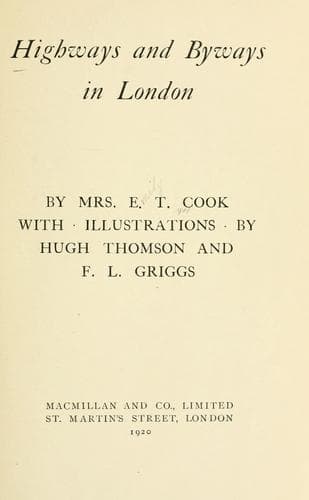
Highways and Byways in LondonCook, Emily Constance Baird
History
Highways and Byways in London
Cook, Emily Constance Baird
London (England) -- Description and travel
The old Church of Chelsea, otherwise St. Luke's,--whose tower of
darkened red-brick lends such picturesque effect to the Battersea
reach beyond the Albert-Bridge,--is, both for its antiquity and its
monuments, one of the most interesting churches in London. Its
interior, never having been "restored," has a very old-world look; and
it still retains, as when it was built, all the simplicity of the
remote village church. Henry Kingsley, whose boyhood was spent in the
delightful old Chelsea rectory, fittingly commemorates his father's
church in his best-known story, "The Hillyars and the Burtons." "Four
hundred years of memory," he makes Joe Burton say, "are crowded into
that old church, and the great flood of change beats round the walls,
and shakes the door in vain, but never enters. The dead stand thick
together there, as if to make a brave resistance to the moving world
outside, which jars upon their slumber. It is a church of the dead."
Dean Stanley greatly loved this church: he used to call it "one of the
chapters of his abbey." Here Sir Thomas More worshipped in the days of
his power, and here, in the chapel that he built, is his monument.
More lived himself near by, in a now vanished mansion called
"Beaufort House," where, in his "fair garden," he received his friend
Erasmus, and also, his king--Henry walking with his arm lovingly
placed about his favourite's neck--that neck he was so soon to
dissever. In Chelsea Church are the famous "chained books," Sir Hans
Sloane's gift; the Bible, the Homilies, and Foxe's Book of Martyrs;
enormous volumes heavily bound in leather with strong clasps, chained,
underneath a bookcase, to a quaint lectern, where they may be read.
This strange custom recalls the monkish days, when printed books were
so rare and costly. The names of the guardian spirits of Chelsea, such
as Lady Jane Cheyne and Sir Hans Sloane,--respectively lady and lord
of the manor, after whom so many streets, squares, and courts have
been christened,--recur here too on elaborate monuments and
sarcophagi. Both were great benefactors to their parish church. Sir
Hans Sloane's daughter was afterwards Lady Cadogan, and hence it was
that the property came into the possession of the Cadogan family.
Public-domain text, read in full here on John Shaqi.
Reviews
Reviews
No reviews yet
Be the first to share your thoughts on this work.
Elsewhere in the archive
Join the Discussion
Join the discussion
Sign in to leave a comment or review.
Sign InorCreate an account