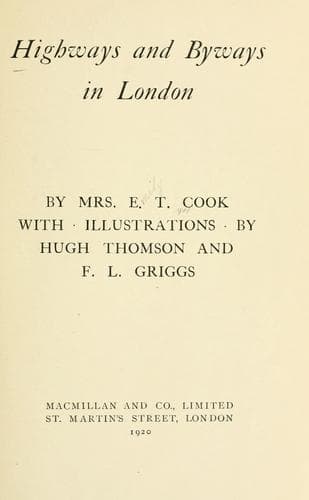
Highways and Byways in LondonCook, Emily Constance Baird
History
Highways and Byways in London
Cook, Emily Constance Baird
London (England) -- Description and travel
"No doubt the Embankment at Chelsea was needed; no doubt the
broad margin of mud which used to fringe old Cheyne Walk was
very unhealthy in summer-time; yet no one who cares for what
is quaint and picturesque, and who clings to relics of the
old days of which we shall soon have no traces left, can
recall the river strand at Chelsea, with its wharfs and its
water-stairs, its barges and its altogether indescribable
but most picturesque aspect, and not feel as he looks at the
trim even wall of the Embankment, and the broad monotonous
pavement above it, even if he does not say in words, 'Oh,
the difference to me!'"
On the site of the ancient tavern is now built "Old Swan House," a
modern-antique mansion designed in a charming style by Mr. Norman
Shaw. A few paces westward from Old Swan House, the modern red-brick
Tite Street, full of artists' studios and of the elect, runs up
towards Queen's Road. Tite Street is, so far as its externals go,
somewhat dark and shut in by its tall houses; but it more than atones
for any outside dulness by the excessive light and learning of its
interiors. "The White House," near the lower end of the street on the
right, was built for Mr. Whistler. Further up the street--also on the
right--is "Gough House," a fine old mansion of Charles II.'s time, now
most happily adapted to the needs of the Victoria Hospital for Sick
Children.
Close to the site of the old "Rotunda" of Ranelagh, is the famous
"Royal Military Hospital," usually called "Chelsea Hospital," and made
familiar to all the world outside London by Herkomer's great pictures,
"The Last Muster" and "Chelsea Pensioners." It was John Evelyn who
first gained Charles II.'s consent to the erection of a Royal Hospital
for veteran soldiers on this site,--though local tradition, apparently
without any reason at all, persists in attributing its foundation to
Nell Gwynne, who, with all her frailties, was ever the people's
darling, and especially a Chelsea darling. The Hospital building--an
open quadrangle with wings,--was designed by Wren. In colour as well
as form, it is solid and reposeful--a noble example of Wren's style
and taste. The gardens, open to the public during the day, have
something of the calm regularity of old Dutch palaces. But then
Chelsea, in building as in horticulture, had always a tendency to the
neat Dutch formalism of William and Mary.
A little north of Chelsea Hospital, between the modern Union Street
and Westbourne Street, stood, in the days of the Georges, the "Old
Original Chelsea Bun-House," that was for so long the resort of
eighteenth-century fashion. Hither used to drive George I. and his
consort, Caroline of Anspach; George III. and Queen Charlotte also
came here in person to fetch their buns home, which, of course, set
the fashion. The old house had a picturesque colonnade; but in 1839
new proprietors rebuilt it; which rash proceeding, however, killed
the custom.
Public-domain text, read in full here on John Shaqi.
Reviews
Reviews
No reviews yet
Be the first to share your thoughts on this work.
Elsewhere in the archive
Join the Discussion
Join the discussion
Sign in to leave a comment or review.
Sign InorCreate an account