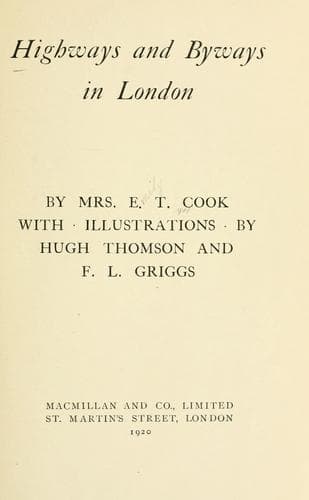
Highways and Byways in LondonCook, Emily Constance Baird
History
Highways and Byways in London
Cook, Emily Constance Baird
London (England) -- Description and travel
The peculiar and somewhat old-world charm of Bloomsbury is, like that
of Chelsea, only made known to her devotees. To the visitor to London,
no less than to the fashionable dweller in the West-End, it is a
grimy, sordid, squalid region, where slums abound, where "no nice
people live," and where mere "going out to dinner" necessitates either
the paying of a half-crown cab fare, or the sacrifice of an hour in
the bone-shaking omnibus. Hence arises the custom of saying that
"Bloomsbury is so far away." Of course, the distance or proximity of
any part of London depends on what one chooses for the centre; but,
taking either Oxford Circus or Charing-Cross--surely natural enough
centres--as the diverging point, Bloomsbury is more central than any
residential part of the metropolis. But even at the play poor
Bloomsbury is maligned; and this, too, notwithstanding the fact that
it is the chosen abode of so many of the theatrical profession. "They
call the place where I live, Bloomsbury," says Mr. Todman, the old
second-hand bookseller of _Liberty Hall_, "though why Bloomsbury, I
don't know; for there ain't so much bloomin' as there is buryin',"
(this, by the way, is a two-edged libel, for Bloomsbury being on high
ground is notoriously healthy). And then the same gentleman goes on to
remark, "they call my 'ouse a ramblin' one, though why it ain't
rambled away to some nicer place, I can't think." We get, from the
same play, a further impression that the Bloomsburians live mainly on
a dish called "Smoked 'Addick." Perhaps the dramatist was led to this
conclusion from the very pervading smell of fried fish that fills
certain "unlovely streets" of cookshops or boarding-houses; where,
however, in my experience the 'addick aroma has always yielded the
palm to that of "sheeps'-trotters" or "stewed eels." Be this as it
may, the old solidly built squares and houses of Bloomsbury have a
dignity of their own. Some of the streets have, it is true, "come down
in the world;" nevertheless, in their decay they retain a mournful
look of having known better days,--a look that even their tenement
rooms,--their broken windows, half-stuffed with paper,--their
shock-headed dirty inmates,--cannot altogether abolish or destroy.
Dickens, who always saw the human side of everything, has often
noticed the peculiar pathos of some of these old, world-forgotten
houses. In his inimitable _Sketches by Boz_ he gives a graphic account
of the gradual decay of a house "over the water." Here, the process is
somewhat similar. First, it changes from a private dwelling-house to a
"select boarding-house"; then, it becomes a friendly, social affair, a
"Home from Home"; then, its area steps become dirtier, its cook sits
on them, shelling peas, and exchanging jokes with the milkman; it
blossoms out in gaudy paint, like a decorator's shop; cracked
flowerpots, of odd shapes and sizes, adorn its windows; and it
descends, by slow degrees, yet further in the scale of "gentility,"
Public-domain text, read in full here on John Shaqi.
Reviews
Reviews
No reviews yet
Be the first to share your thoughts on this work.
Elsewhere in the archive
Join the Discussion
Join the discussion
Sign in to leave a comment or review.
Sign InorCreate an account