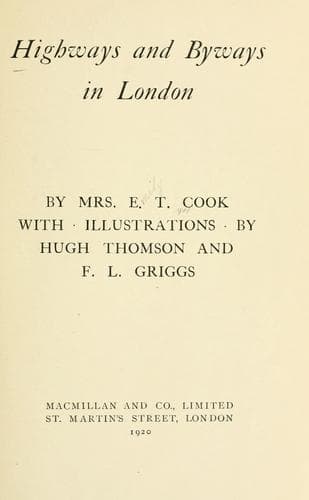
Highways and Byways in LondonCook, Emily Constance Baird
History
Highways and Byways in London
Cook, Emily Constance Baird
London (England) -- Description and travel
till finally it becomes a mere tenement house, its juvenile population
going in and out with jugs of beer, its area railings hung round with
pewter milk-pots, and its door ornamented with a row of half-broken
bell-chains for the different occupants. And, if you should chance,
too hurriedly, to ring one of these in search of a special inhabitant,
ten to one a cross, dirty-faced female will appear, grumbling: "Can't
yer see as _this_ 'ere is Mrs. Smith's bell?--Two pair back--ye've
rung the wrong 'un!"
The Bloomsbury houses are pathetic, however, not so much from age, as
because their glory has departed,--because they have had their day,
and ceased to be; for, in the matter of actual age, few of them date
back farther than the end of the eighteenth century. Queen Square,
indeed, which is far prior to any of its neighbouring squares, was
laid out in the reign of Queen Anne, in whose honour it was named, and
whose statue still adorns it. It is a curiously shaped square, for,
though enclosed, no houses were built at the northern end; this
arrangement was made for the sake of the fine view of the hills of
Highgate and Hampstead, that the square then commanded. Strange
transformation! The Bloomsbury that we know was then all fields; the
houses of Queen Square being, so to speak, the last sentinels of the
London of that day! Rocques' map of 1746 gives no houses beyond the
northern end of Southampton Row. Between Great Russell Street and the
present Euston Road, was then open country,--called, first, the "Long
Fields,"--then "Southampton Fields," or "Lamb's Conduit Fields."
Earlier, they were famous for their peaches and their snipes; but in
about 1800 they were mainly waste ground, where brawling and
disorderly sports took place, and where superstition asserted that,
two brothers having fought there about a lady, the footsteps they made
in their death-struggle would never again grow grass or herb! "The
Brothers' Steps," the place was called, or, "The Field of the Forty
Footsteps." The present Gordon Square is said to be built upon the
exact spot. The place had, however, always been rife with
superstition; for here, on Midsummer-Day, in the 17th century, young
women would come looking for a plantain leaf, to put under their
pillows, so that they should dream of their future husbands. From
these fields could be seen, in 1746 and far later, but two or three
nobles' mansions, enclosed in their gardens,--such as "Bedford House,"
pulled down to build Bedford Square,--"Baltimore House," long since
built into Russell Square,--and "Montague House," now rebuilt as the
British Museum;--with the old "Whitefield's Tabernacle" appearing
through the trees towards the gardens of the ancient manor of "Toten
Court," which gave its romantic name to the essentially unromantic
Tottenham Court Road. (The ugly "Adam and Eve" public-house, at the
junction of Euston Road and Tottenham Court Road, now occupies the
Public-domain text, read in full here on John Shaqi.
Reviews
Reviews
No reviews yet
Be the first to share your thoughts on this work.
Elsewhere in the archive
Join the Discussion
Join the discussion
Sign in to leave a comment or review.
Sign InorCreate an account