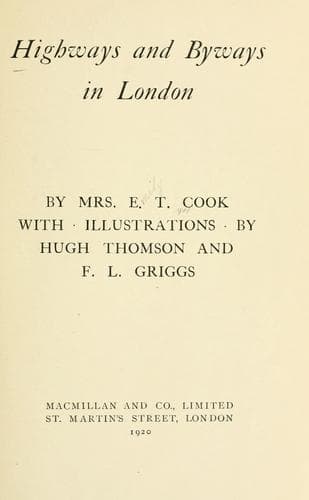
Highways and Byways in LondonCook, Emily Constance Baird
History
Highways and Byways in London
Cook, Emily Constance Baird
London (England) -- Description and travel
place both of the old tavern of that name, and the older manor-house.)
The name "Bloomsbury" is, however, of more remote date; it is, like
most London appellations, a "corruption," and comes from
"Blemundsbury," the manor of the De Blemontes, or Blemunds, in the
reign of Henry III. Later, the manor of Bloomsbury came, together with
that of the neighbouring St. Giles, into the possession of the Earls
of Southampton, till in 1668 it passed with Lady Rachel,--daughter of
Thomas Wriothesley, last Earl, by her marriage with Lord William
Russell,--into the family of the Dukes of Bedford, the present owners.
Lord William Russell,--who was beheaded, without a fair trial, in
Lincoln's Inn Fields in 1683, for supposed connection with the famous
Rye House Plot,--lived in Bedford House (formerly Southampton House),
on the northern side of Bloomsbury, originally Southampton, Square.
(The house occupied the whole north side of the square until pulled
down in 1802, after the illustrious Russells had lived there for more
than 200 years.) This was the house admired by Evelyn, in an entry in
his diary of February 9, 1665: "Dined at my Lord Treasurer's, the
Earle of Southampton, in Blomesbury, where he was building a noble
square or piazza, a little towne; some noble rooms, a pretty cedar
chapel, a naked garden to the north, but good aire". It was at first
intended that Lord William Russell should suffer in Bloomsbury Square,
opposite his own residence; but this was apparently opposed by the
King as too indecent.... Poor, heroic Lady Rachel Russell! She lived
here in retirement till her death, at the age of 86, in the reign of
George I. She had, indeed, like Polycrates, given her treasured
"ring", and could fear no more from fate. The great landlords of
London may get their "unearned increment" easily enough now, yet they
had to pay the penalty of greatness in the past!
Bloomsbury Square, though now rapidly becoming simply a square of
offices and business premises generally, was, in the time of Charles
I, the most fashionable and most admired Square in London. Pope,
later, alludes to it in the following couplet:
"In Palace yard, at nine, you'll find me there--
At ten, for certain, sir, in Bloomsbury Square--"
Public-domain text, read in full here on John Shaqi.
Reviews
Reviews
No reviews yet
Be the first to share your thoughts on this work.
Elsewhere in the archive
Join the Discussion
Join the discussion
Sign in to leave a comment or review.
Sign InorCreate an account