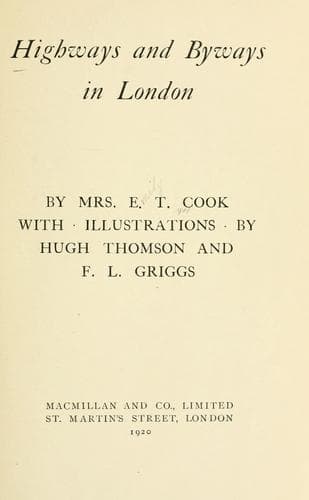
Highways and Byways in LondonCook, Emily Constance Baird
History
Highways and Byways in London
Cook, Emily Constance Baird
London (England) -- Description and travel
Whitefield's Tabernacle, that early home of Dissent,--where, in 1824,
Edward Irving delivered his famous missionary oration of
three-and-a-half hours,--stands near by in Tottenham Court Road.
Erected first by the preacher George Whitefield in 1756, and called
then "Whitefield's Soul Trap,"--it has been many times rebuilt,--and
is now just re-opened as an imposing red-brick and ornate edifice, on
its original site. Notwithstanding its deplorable newness, it
perpetuates the memory of Whitefield, Toplady, and John Wesley; and it
was here, by a curious coincidence, that two ministers preached their
own funeral sermons!
With Carlyle too, although his chosen home was in far-away Chelsea,
Bloomsbury has associations. At No. 6 Woburn Buildings,--in a dingy
little paved by-way close to New St. Pancras Church, Euston
Road,--Carlyle lodged for a short time in 1831--when trying to get his
_Sartor Resartus_ taken by a publisher. In these lodgings ("a very
beautiful sitting-room, quiet and airy" he describes it), Edward
Irving, his friend, had also stayed. And 5 Ampton Street, Mecklenburgh
Square, was another London lodging of Carlyle's--frequented before the
Chelsea days began in 1834. But, of the many literary men who have
lived in and around Bloomsbury, none is more associated with the
locality than Charles Dickens. Tavistock House has been recently
pulled down; it was an unassuming, ugly, semi-detached dwelling with a
heavy portico, one of three houses all now destroyed, railed off from
the eastern side of Tavistock Square, and entered from it through an
iron gateway. This was the novelist's home for ten years, from 1850 to
1860. He, and his famous New Year's theatricals, are still a
recollection of the older residents in the neighbourhood. The annual
plays of Tavistock House, performed "in a theatre erected in the
garden," and written and stage-managed under the collaboration of
Wilkie Collins and Charles Dickens, are now matter of history. _Bleak
House_ was the earliest work written here. The house after Dickens's
time became a Jews' college, and the pupils "recreated" in the
novelist's theatre-garden. It is now a sad scene of desolation.
Memories of Bloomsbury haunt many of Dickens's works, but none are
better or more lifelike in their way than his early sketches of the
immortal Mrs. Tibbs--type of her class--and her select boarding house
in Great Coram Street, in "that partially explored tract of country
which lies between the British Museum and a remote village called
Somers Town." Mrs. Tibbs's advertisement to the effect that "six
individuals would meet with all the comforts of a cheerful musical
home in a select private family, residing within ten minutes' walk of
everywhere," is still not uncommonly met with.
Public-domain text, read in full here on John Shaqi.
Reviews
Reviews
No reviews yet
Be the first to share your thoughts on this work.
Elsewhere in the archive
Join the Discussion
Join the discussion
Sign in to leave a comment or review.
Sign InorCreate an account