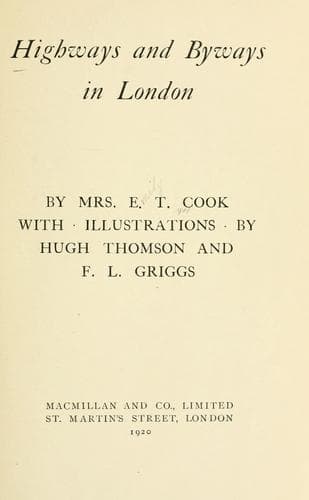
Highways and Byways in LondonCook, Emily Constance Baird
History
Highways and Byways in London
Cook, Emily Constance Baird
London (England) -- Description and travel
But the literary memories of Bloomsbury are like the sands of the sea
for multitude. They may be found even in the dingy streets running
east of Tavistock Square, leading north towards the tram-lines and
general squalor of King's Cross. At No. 26 Marchmont Street, the
youthful Shelley and the still more youthful Mary Godwin, afterwards
Shelley's second wife, lived in 1815, before Harriet's death and their
own legal marriage; and here their first baby was born and died.
"Shelley and Clara go out about a cradle," Mary's diary records, a few
days after the infant's birth. Here Mary read _Corinne_ and
_Rinaldini_, and mourned over her little dead child, "a span-long dead
baby, and in the lodgings in Marchmont Street an empty cradle."
Possibly Marchmont Street then was not quite so slummy as it is now;
but this young couple, treading "the bright Castalian brink and
Latmos' steep," were probably just as unconscious of London mud as of
any disorder, actual or moral, in their establishment.
At 54, Hunter Street, a street just east of Marchmont Street, and now
exhibiting, in all its phases, the gradual decay described by Dickens,
John Ruskin was born in 1819; and here, as he describes in
_Præterita_, he used, at the age of four, to enjoy from his nursery
window "the view of a marvellous iron post, out of which the
water-carts were filled through beautiful little trap-doors, by pipes
like boa constrictors," a mystery which, he says, he was never weary
of contemplating. If any such little observant boy should happen to
live there now, he would have something further to contemplate, to
wit, the frequent green omnibuses, for this is now the much-travelled
omnibus route between the stations of King's Cross and Victoria.
Hunter Street runs into Brunswick Square, where, at No. 32, the
_Punch_ artist John Leech lived for ten years, and suffered many
afflictions at the hands of persistent organ-grinders, who, if they
did not really shorten his life, at any rate aggravated the illness of
which he died. London is conservative in its habits, and
organ-grinders, trooping in from their neighbouring home of Hatton
Garden--even occasionally a low type of nigger minstrels--still haunt
this spot, as they do all places, for that matter, where
boarding-houses congregate. The regular attendance of what is termed a
"piano-organ" always denotes a boarding-house; the louder its screech
the better, for the boarder seems fond of noise. His mode of life is
peculiar and unique. He will sit on the balcony smoking, or eat his
dinner with his friends almost in public; it is all the same to him.
Such sign-manuals betray the "select boarding establishment" almost as
much as does the row of five ornate cracked glazed pots, yellow and
blue alternately, that adorn its lower windows; or to quote Dickens:
"the meat-safe looking blinds in the parlour windows, blue and gold
curtains in the drawing-room, and spring roller blinds all the way
Public-domain text, read in full here on John Shaqi.
Reviews
Reviews
No reviews yet
Be the first to share your thoughts on this work.
Elsewhere in the archive
Join the Discussion
Join the discussion
Sign in to leave a comment or review.
Sign InorCreate an account