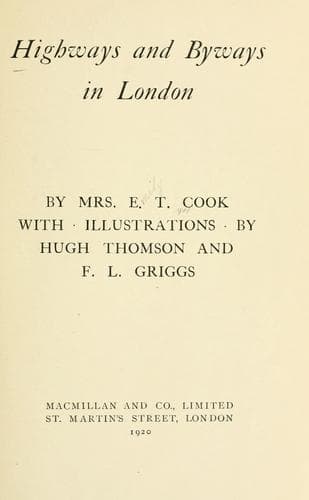
Highways and Byways in LondonCook, Emily Constance Baird
History
Highways and Byways in London
Cook, Emily Constance Baird
London (England) -- Description and travel
"Why, lace, and bits o' ribbon, put up in odd lots for sale, things
lying about loose on the counter, like they are at sale times.
Well-dressed they are, too, you wouldn't think they could want 'em
badly. 'Oh, it must 'a got up my sleeve,' some of 'em say, looking
most innocent, with perhaps two or three yards of brocade or surah
hangin' out of their golf-capes.... They've got a kind of a fancy, as
well, for religious books: no knowing why, for religion," added the
shop-walker thoughtfully, "has evidently done them no good."
With which reflection I cordially agreed.
Sales, however tempting, should be avoided by the unwary shopper, for
they are dangerous as spiders' webs. They usually occur twice a year,
in January and July; in January, they relieve the tedium of the winter
fogs; in July, they are a very midsummer madness. The sales vary in
honesty. Some of them are really held in order to clear out, at a
sacrifice, the "old stock"; some, especially in the smaller shops, are
simply quick sales of "cheap lines," bought in on purpose, and strewn
about heterogeneously on the counters. Sale days are truly terrible
experiences to the uninitiated. If you happened, unwittingly, to go to
some familiar shop on one of these yearly occasions, the mass of
crowded, struggling, gasping humanity, nearly all pushing, and nearly
all fat, would lead you to imagine that life and death, at least, were
intimately concerned in the tussle, instead of merely the question of
securing the "first choice" of "Remnants."
The shopping, however, of the rich is one thing, and the shopping of
the very poor is quite another. Most interesting, to those who care to
study the book of human nature, are the "street-markets" of the
people, those rows of noisy booths and barrows which have stood from
time immemorial, by traditional right, in certain streets, and where
jets of brilliant, flaring naptha-lights display the kaleidoscopic
stock-in-trade. Among such streets are Goodge Street, Tottenham Court
Road; Leather Lane, Holborn; or, to descend to a yet lower social
depth, Brick Lane, Spitalfields. Booths and barrows are, as everybody
knows, not allowed to obstruct the majority of streets, being
generally limited to slums or wretched paved alleys; here, however,
the authorities evidently make exceptions in favour of certain ancient
vested rights. In Goodge Street fruit and vegetables are mainly sold;
in Leather Lane, tools, appliances, pedlars' wares, butchers' meat;
everything, in fact, in infinite variety; in Spitalfields, birds and
live-stock, together with old clothes, and second-hand articles
generally. In such street-markets, from eight to ten on Saturday night
is the gala time for business. M. Gabriel Mourey says:
Public-domain text, read in full here on John Shaqi.
Reviews
Reviews
No reviews yet
Be the first to share your thoughts on this work.
Elsewhere in the archive
Join the Discussion
Join the discussion
Sign in to leave a comment or review.
Sign InorCreate an account