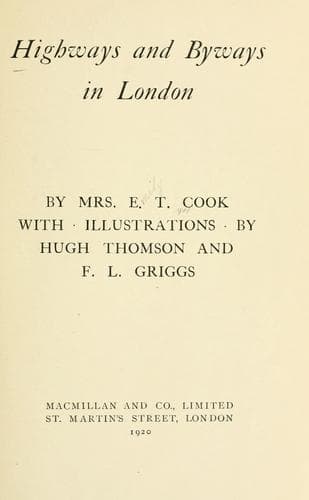
Highways and Byways in LondonCook, Emily Constance Baird
History
Highways and Byways in London
Cook, Emily Constance Baird
London (England) -- Description and travel
The collection of Tanagra figurines, on the upper floor, near the
Jewel Room, is one of the most interesting departments in the Museum.
Here, in a small compass, you may follow the whole development of the
plastic art, from the rudest clay effigies and caricatures, to the
most lovely realisation of the Greek feeling for beauty. Some of the
ladies, with their palm-leaf fans and "Liberty" draperies, seem hardly
to come to us from the tomb; have we not met and loved them in our own
day? Their dresses, their attitudes, are so modern, even their hair is
arranged in the present styles. Especially charming are two damsels in
tea-gowns, leaning earnestly towards one another, enjoying some choice
bit of gossip. And there are two figures in this particular gallery,
in which I claim to take a quite special interest; having seen them,
so to speak, in their transition stage. It happened thus: When I was
in Athens some few years back, a waiter, taking us no doubt for "rich
English milors," said, in a stage whisper, that he had some fine
things to dispose of. He kept them, he said, for safety in the cellar.
So to the cellar he went, and produced, from many wrappings of
cotton-wool, the treasures:--that very winged Eros and that same
pirouetting ballet-dancer that now adorn one of the central
wall-cases. Alas, in our case, that waiter was doomed to
disappointment. He wanted no less than £40 for the Eros and £30 for
the ballet dancer; and they were returned to their cotton-wool and to
the cellar. But, a twelvemonth passed, and behold! one fine day we
recognised with joy our old friends in the familiar surroundings of
the British Museum!
Many of the British Museum treasures have, like that winged Eros,
endured strange vicissitudes of fortune. The great "Elgin"
marbles,--those sculptures from the Parthenon so long furiously raged
over in print on the much-vexed charge of vandalism in appropriation,
and still more furiously threatened by the rage of the sea on their
transit from the Acropolis,--were, indeed, shipwrecked on their way
here. Then there are the contents of the "Mausoleum" Room, the whole
story of the discovery of which, by Sir Charles Newton at
Halicarnassus, in 1856 is like one long romance. Other objects recall
various stories. The familiar bust called "Clytie," for instance, so
admired by Carlyle, and so familiar in drawing schools, was the most
cherished possession of Mr. Townley, who "escaped with it in his arms
when he was expecting his house to be sacked during the Gordon riots."
"Fortunately," says the chronicler, "the attack did not take place,
and Mr. Townley's wife, as he called her, returned to her companions."
The corridors of the British Museum, that suggest such boredom to the
uninitiated, are full of such stories. So much we know, but, ah! if
these stones could only tell their histories, and let the full light
into their chequered past!
Public-domain text, read in full here on John Shaqi.
Reviews
Reviews
No reviews yet
Be the first to share your thoughts on this work.
Elsewhere in the archive
Join the Discussion
Join the discussion
Sign in to leave a comment or review.
Sign InorCreate an account