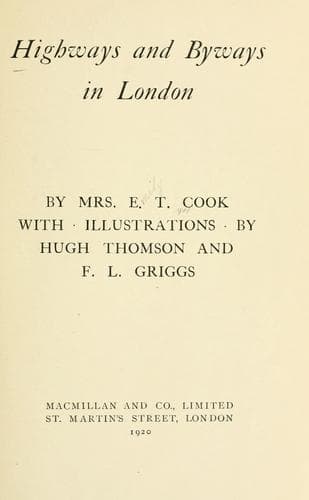
Highways and Byways in LondonCook, Emily Constance Baird
History
Highways and Byways in London
Cook, Emily Constance Baird
London (England) -- Description and travel
The National Gallery cannot be seen in one visit. For any real
appreciation of the vast collections, ten, twenty visits rather are
needed; visits that need never, now, be other than a pleasure; the
improved conditions making the place itself attractive, and whatever
light is obtainable in London finding its way to those large and lofty
galleries. The mass of "the People" mainly frequent the British
Schools; and, even in the larger portion of the building occupied by
the Foreign Schools, every room has usually, like the London
collections generally, its special votaries. For instance, in the
little room devoted to the Early Sienese painters, you will nearly
always find a few earnest students, making pencil marks on note-books
or in elaborate catalogues; in the long Italian Gallery they are,
perhaps, just a trifle less severe, but are still more or less of the
same type, sitting in rapt contemplation and still with catalogues;
but the Dutch School is already more flippant, and but few catalogues
survive into the Spanish and French Schools.
The romance of the National Gallery,--what volumes might not be
written on the fascinating subject! If, here again, old pictures could
tell stories of their past, what adventures could they not relate! The
long corridors of the National Gallery, filled with masterpieces from
all nations and ages, would of themselves furnish as copious records
as many a shelf in the British Museum Library. What stories might
these pictures tell: of their painting, their owners, the generations
to which they have served as the Lares and Penates, the families whose
vicissitudes they have shared! This, maybe, had hung for years,
blackened and tarnished, in a pawnbroker's shop till some vigilant eye
rescued it from its oblivion; that, perhaps, had saved its owner's
life, or redeemed the fortunes of a nation. This, again, formed the
"wedding-chest" of a beautiful dark-eyed bride, dust long ago; that
caused the imprisonment, almost the death, of its author. Unhappily,
old pictures are "silent witnesses" of history. We can, indeed,
discover, through much searching in dusty archives, the _provenance_
of a few of our most celebrated pictures, or read, perhaps, one or two
of the stories relating to them; but how many are there of which we
have not been able to find a record? It depends mainly on chance what
stories survive, and what do not. Then, such as are known are often
not widely known; they lie hidden, for the most part, in musty
blue-books, or in tomes of ancient lore, attainable by the student
only. The mere title, _The Cornfield_ or _The Repose_, tells so
little. Does it not add to our interest in the pictures to know that
the one was thought by Constable to be his best work, and that the
scene of the other was laid among the hills of Titian's own country?
In connection with the inscriptions on the frames, most visitors, I
fancy, will share the disappointment I felt, when on revisiting the
Public-domain text, read in full here on John Shaqi.
Reviews
Reviews
No reviews yet
Be the first to share your thoughts on this work.
Elsewhere in the archive
Join the Discussion
Join the discussion
Sign in to leave a comment or review.
Sign InorCreate an account