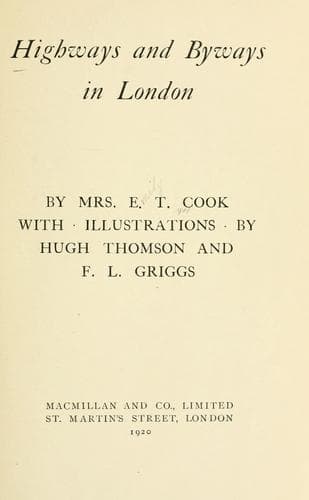
Highways and Byways in LondonCook, Emily Constance Baird
History
Highways and Byways in London
Cook, Emily Constance Baird
London (England) -- Description and travel
Gallery one day I found the familiar "Raphael" disguised as "Sanzio,"
"Tintoret," as "Robusti" and so forth; but this somewhat pedantic
innovation has now been partially remedied.
The early Italian pictures were usually painted to adorn particular
places; some, perhaps, to decorate a wooden chest for the furnishing
of a room, as Benozzo Gozzoli's _Rape of Helen_; others to consecrate
an altar, as Raphael's _Madonna_; many to assist in the carrying out
of some architectural design, as in Crivelli's pictures, or Fra
Filippo Lippi's _Vision of St. Bernard_. All, at any rate, were
painted, not to hang in rows in a gallery, but for particular persons,
places, and occasions, far removed from the present environment of
them. Perhaps our only pictures specially painted with a view to the
Gallery which they now adorn, are those in which Turner's rivalry with
Claude is immortalised. Visitors may wonder why, in a room devoted to
the French School of Painting, they are suddenly confronted with two
large canvases of Turner's. The fact is that Turner painted them in
direct competition with Claude. The great modern landscape-painter
determined to beat the ancient on his own classical ground. Whether he
has conquered is indeed a question; but the pictures still hang side
by side in unconscious rivalry, telling the pathetic story of the dead
man's ambition. Turner, who left these two pictures, among many
others, to the nation, expressly stipulated that they should hang
between those two by Claude. In vain, during his life, large sums were
offered for them; he steadily refused to sell. "What in the world,
Turner, are you going to do with it?" his friend Chantrey asked,
referring to the _Carthage_. "Be buried in it," Turner replied grimly,
keeping its real destination a secret.
There are in the National Gallery some pictures actually painted for
the sitters to be buried in. These are the early Græco-Egyptian
portraits, which glare down upon us in the vestibule. A few years ago
a workman's spade, digging in the Fayoum, accidentally struck against
a mummy-case. Affixed to the outside covering, in a position
corresponding to the head of the corpse, was a portrait of a man in
his habit as he lived. That "find" led to others. Some dozen tombs,
closed 1,500 years ago, were rifled in order to supply a fresh link in
the historical development of art as exhibited in our National
Gallery.
Public-domain text, read in full here on John Shaqi.
Reviews
Reviews
No reviews yet
Be the first to share your thoughts on this work.
Elsewhere in the archive
Join the Discussion
Join the discussion
Sign in to leave a comment or review.
Sign InorCreate an account