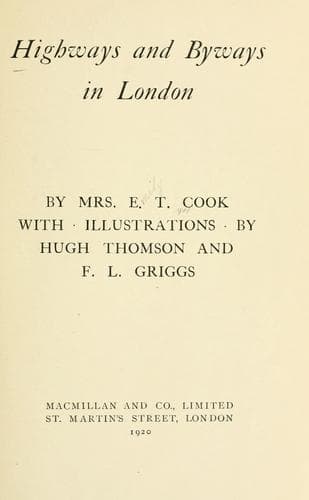
Highways and Byways in LondonCook, Emily Constance Baird
History
Highways and Byways in London
Cook, Emily Constance Baird
London (England) -- Description and travel
If great men's houses, or the houses that great men have ever,
temporarily, lived in, could all be designated by some unobtrusive
memorial tablet, such, for instance, as the Carlyle bas relief at
Chelsea,--or even a plain inscription such as those recently placed on
John Ruskin's birthplace in Hunter Street, Reynolds's house in
Leicester Square, and Sir Isaac Newton's in St. Martin's Street,--what
an interest would it not lend to even "long and unlovely" London
streets! For the romance of houses is not divined by instinct; and
even the taste of a Morris or a Rossetti has not always left its mark
on their London abodes. That Dickens, Thackeray, John Leech, Darwin,
the Rossettis, William Morris, have all lived in and about Bloomsbury,
is not patent to the casual visitor. Does not even the plain
inscription, "Poeta Inglese, Shelly," (_sic_) lend an added glamour to
the Lung' Arno of Pisa?
The dividing line between history and fiction is not always very
strongly marked; and this leads us to consider yet another aspect of
the question. A curious literary interest sometimes attaches to
certain houses, an interest hardly less deep for being partly, or even
purely, fictitious. Among the many novelists who have made themselves
responsible for this, none, perhaps, have been more prominent than
Charles Dickens. Dickens, whose knowledge of London was, like his own
Sam Weller's, "extensive and peculiar," has invested certain houses,
certain localities, with an almost human sentiment and pathos.
Thackeray has also done much, yet not so much as his contemporary,
towards making London stones famous. The tenants of "historic houses"
in this sense--houses on whom these and other writers have conferred
immortality--are, of course, merely the "ghosts of ghosts," and yet,
how real, how persistent are they, with the majority of us! Harry
Warrington enjoying the May sun from his pleasant window in Bond
Street; old Colonel Newcome kneeling among the "Grey Friars" of the
Charterhouse; the pretty old house and garden in Church Street,
Kensington, where Miss Thackeray's charming heroine, Dolly, lived;
little David Copperfield at the waterside blacking warehouse; poor
weeping Nancy on the steps of Surrey Pier, by London Bridge; ragged Jo
at the grating of the squalid burying-ground: they and their sorrows
are more real, more vivid, to us than the actual sufferings of the boy
Chatterton, the "Titanic" agony of spoiled Byron, or the short glories
of Lady Jane Grey. And, indeed, when we call to mind the gay vision of
the "ladies of St. James's" taking the air, we think as much of such
personages as Thackeray's beautiful Beatrix, wayward and heartless,
and of her solemn cousin, Colonel Esmond,--as of Mrs. Pepys, in her
noted "tabby suit," or of my Lady Castlemaine herself, in all her
beauty, attended by her royal admirer.
Public-domain text, read in full here on John Shaqi.
Reviews
Reviews
No reviews yet
Be the first to share your thoughts on this work.
Elsewhere in the archive
Join the Discussion
Join the discussion
Sign in to leave a comment or review.
Sign InorCreate an account