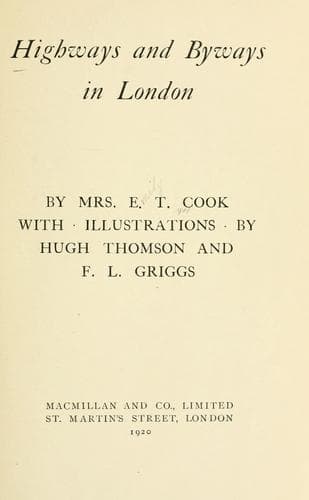
Highways and Byways in LondonCook, Emily Constance Baird
History
Highways and Byways in London
Cook, Emily Constance Baird
London (England) -- Description and travel
of the old Stuart Palace of Whitehall, or to say where was the special
site of the historic Cockpit,--yet, do they not lend a glory and an
attraction to all the district of Westminster? Do not the purlieus of
the unromantic Borough High Street, murky as these often are, recall
Chaucer's famous Tabard Inn, of Canterbury pilgrims' fame? and does
not the much-abused Griffin, on its Temple Bar pedestal, memorialise
the older and too obstructive arch, where of old the dreadful heads of
political scapegoats were displayed?
Vanished, and every year still vanishing, treasures! Sooner or later,
no doubt, the edifices made sacred by history and association must go
the way of all brick and masonry; yet even such landmarks as Turner's
poor riverside cottage at Chelsea, or Carlyle's modest abode in Cheyne
Walk, it will be sad to part with. That curious humanity that Charles
Dickens gave to houses makes itself again felt in their fall;
dwellings are not immortal, any more than were their great occupants.
There is no picturesque decay in London; what is not of use must go:
it dare not cumber the precious ground. Therefore, the few remaining
timbered fronts of London are gone or going; only recently some
picturesque old red-roofed houses, in the close vicinity of New Oxford
Street, were condemned and destroyed; Staple Inn, indeed, has been
saved and patched up, owing to the prompt action of a band of public
benefactors. Blocks of houses, forming whole streets, are continually
washed away in the tide of progress; Parliament Street has
disappeared; the old Hanway Street, as it once was, has lately gone;
Holywell Street is of the past; the demolition of this latter, though,
indeed, urgently needed for the widening of the "straits" of the
Strand, was not without its special sadness. The decay of houses that
are at once picturesque and historical is, of course, doubly
afflicting; yet even ugly houses often retain the charm of association
to those who know what memories are bound up with them. Here romance
and history serve to lend the beauty that is lacking. Thus, Ruskin's
prosaic home in Hunter Street, Thackeray's commonplace mansion in
Onslow Square; the house in Half Moon Street where Shelley sat "like a
young lady's lark," in a projecting window, "hanging outside for air
and song;" even that dark corner in Mecklenburgh Square where Sala
kept his curios and bric-à-brac, all have their peculiar charm. Dr.
Johnson's house in Gough Square, Fleet Street; the so-called "Old
Curiosity Shop" in Lincoln's Inn Fields; John Hunter's house in
Leicester Square--are all threatened with demolition. And, even apart
from historic interest, how sad is the frequent fall of London's old
landmarks! Tottering buildings, mere derelicts of time, old houses----
"whose ancient casements stare,
With sad, dim eyes, at the departing years."
Instinct as they are with the pathos of humanity, the sword of
Damocles hangs over them all.
Public-domain text, read in full here on John Shaqi.
Reviews
Reviews
No reviews yet
Be the first to share your thoughts on this work.
Elsewhere in the archive
Join the Discussion
Join the discussion
Sign in to leave a comment or review.
Sign InorCreate an account