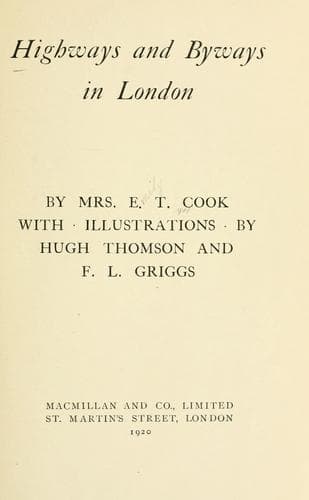
Highways and Byways in LondonCook, Emily Constance Baird
History
Highways and Byways in London
Cook, Emily Constance Baird
London (England) -- Description and travel
These old waifs and strays were not, apparently, even always grateful.
But, in any case, the annoyance of "such a menagerie of singular
oddities" must have driven him more and more to his clubs, and
especially to his favourite haunt the "Cheshire Cheese." This ancient
tavern, still existing in its pristine simplicity in Wine Office
Court, "and," says Hare, "the most perfect old tavern in London," is
the classic retreat where Johnson and Goldsmith held their court;
Johnson in the window-seat, and Goldsmith on his right hand. To
American tourists, I gather, it is a specially sacred place of
pilgrimage. In that low, dark, sanded parlour of the "Cheshire
Cheese," you might easily imagine yourself in some rural retreat,
miles away from London, though so close in fact to the din and
civilisation of Fleet Street. Not only far from London, but far away
back in the eighteenth century. Can such things be, you wonder, in the
London of our day? You sit in Johnson's time-honoured seat, under his
brass-plate inscription, and his picture; darkened oak panelling lines
the walls; artistic Bohemians blow smoke-wreaths over their toasted
cheese and whiskies, hilariously in yonder corner; and even the
waiters are not of the uncommunicative, cut-and-dried modern sort, but
rather the cheery, jovial order of Dickens's time. One of them brings
you the "visitors' book"; two ponderous tomes filled with brilliant
sketches by well-known artists, some of the sketches amiably
suggestive of the sketchers having supped "not wisely, but too well";
another tells you, with all the pride of long association, that "the
place has not changed one whit since Johnson's time"; and yet a third,
with an expansiveness rare indeed in London, will point out to you
"Goldsmith's favourite window-seat."
Oliver Goldsmith, the erratic genius who "wrote like an angel, and
talked like poor Poll," was one of Johnson's satellites, another
shining light of old Fleet Street. He had the artistic temperament
indeed, for when he was not in the clutches of the bailiffs, he was
usually revelling in absurd extravagance. Goldsmith's last lodging, in
No. 2, Brick Court, Temple, he furnished with ridiculous lavishness,
dressing himself to match, in "Tyrian-bloom satin with gold buttons."
Dr. Johnson must sometimes have been tried by his friend, as the
following story shows: (Newbery, Goldsmith's publisher, had apparently
refused further advances to his impecunious client):
Public-domain text, read in full here on John Shaqi.
Reviews
Reviews
No reviews yet
Be the first to share your thoughts on this work.
Elsewhere in the archive
Join the Discussion
Join the discussion
Sign in to leave a comment or review.
Sign InorCreate an account