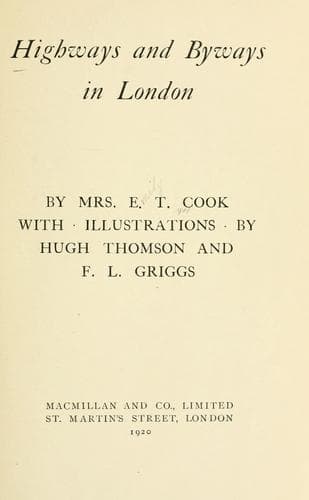
Highways and Byways in LondonCook, Emily Constance Baird
History
Highways and Byways in London
Cook, Emily Constance Baird
London (England) -- Description and travel
Oh, London! beautiful London! who would not be with thee in May? Paris
should not, surely, be recommended as the only Mecca of that lovely
month. When the London street authorities, with unwonted forbearance,
have for one brief moment suspended their incessant repairing of the
busiest thoroughfares; when the hanging gardens of Park Lane, and the
window-boxes of Seven Dials, alike display their "pavilions of tender
green"; when Piccadilly is blocked with traffic; when Rotten Row is
thronged with the smart world; when the shops hang out their
daintiest spring fashions; when the gay parterres of the Parks show
flowers of kaleidoscopic brilliance, and their sylvan seclusions
suggest the "real country," what can be more delightful than our own
often-maligned metropolis?
The Parks of London are, perhaps, the element that most surprises the
foreigner unused to English tastes and ways. Here are neither the
leafy terraces and regular alleys of German capitals, nor the trim
well-clipped boscages and levels of Versailles and the Tuileries; but
only mere stretches of park-like greensward, dotted here and there, in
charming irregularity, with old trees of noble girth. Walks there are,
indeed, and footpaths, shrubberies, and flower-beds; but the chief
area of the London Parks is, ever and always, this fresh, radiant,
undulating turf, turf which here, more than ever, suggests the little
Board School girl's answer to a question on general knowledge: "Turf,
ma'am, is grass and clean dirt put together by God."
Of Hyde Park, the largest and oldest of the London Parks, Disraeli
said truly in one of his novels: "Hyde Park has still about it
something of Arcadia. There are woods and waters, and the occasional
illusion of an illimitable distance of sylvan joyance." The history of
Hyde Park is the history, generally, of Greater London; first
monastery grounds, then royal demesne, then again, the people's. Some
of the old trees may even have seen the ancient manor of Hyde; some of
them must certainly recall the time when this was a royal Tudor
hunting-ground, well-stocked with deer. Many of its fine old
timber-trees have, however, disappeared, so that the famous "Ring" of
Charles II.'s time can be now but imperfectly traced.
Public-domain text, read in full here on John Shaqi.
Reviews
Reviews
No reviews yet
Be the first to share your thoughts on this work.
Elsewhere in the archive
Join the Discussion
Join the discussion
Sign in to leave a comment or review.
Sign InorCreate an account