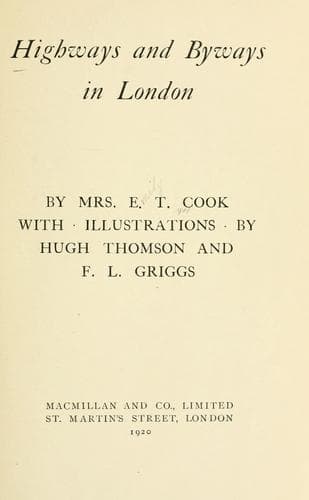
Highways and Byways in LondonCook, Emily Constance Baird
History
Highways and Byways in London
Cook, Emily Constance Baird
London (England) -- Description and travel
The Parks are, naturally, "the lungs of London." Were it not for these
large "open spaces," so mercifully preserved to us by the wisdom and
farsightedness of former rulers and legislators, the health of the
great city would hardly now be what it is. The little town of the
early centuries, Roman, Saxon, or Norman, surrounded by country woods
and pastures,--dotted with the gardens of merchants and magnates, as
well as with frequent convent closes, orchards, and leafy
precincts,--had small need of such vast pleasure-grounds. For London,
even in Elizabeth's day, consisted (as shown in Aggas's map), of only
two tiny townlets, "London" and "Westminster"; beyond, all was open
fields. Tottenham Court Road, that dreary thoroughfare of ugly
modernity, was the solitary manor of "Toten Court," a sylvan resort
for "cakes and creame": Chelsea was a pretty, distant riverside
hamlet; Regent Street and Bond Street were cows' pastures, and the
"flowery fields" of "Marybone" were altogether in the rural distances.
Who, indeed, would recognise the present Regent's Park in these lines
(from an old play called "Tottenham Court"):
"What a dainty life the milkmaid leads,
When o'er these flowery meads
She dabbles in dew,
And sings to her cow,
And feels not the pain
Of love or disdain...."
But if, to the London of old time, the Parks were not necessary, to
modern London, which has more than doubled its population and its area
in the last century and a half, they are an unspeakable boon. Our
forefathers were wise in their generation when they secured these
stretches of the outlying country for public use. We, too, in our own
day, make similar efforts, efforts of which the recent preservation of
Parliament Fields, of part of Caen Wood, affords sufficient proof. In
that far-off day, prophesied by "Mother Shipton," when "Primrose Hill
shall be the centre of London," such breathing spaces, such oases in
the wilderness of bricks and mortar, would prove of quite incalculable
value.
Happily, London, even in her rampant growth, is often jealously
mindful of her responsibilities. Though our city boasts no such
spacious boulevards as are to be seen in Paris, trees are often now
planted at intervals on the sidewalks in many of the newest
thoroughfares, and a few of the older streets are being widened and
improved. Very few are the London views, as I have said elsewhere,
that are not in a measure enlivened by foliage or greenery.
The colouring of London is a thing peculiar to itself; it requires to
be specially studied, even by painters whose eyes are trained to
observation. Its wonderful atmospheric effects have been only more or
less recently recognised by them. Very few artists have rendered
thoroughly the strange cold light on the London streets; cold, yet
suffused by an underlying glow, by a warmth of colour hardly at first
guessed by the spectator. Even a rainy day of London greyness--what
does the poet's eye see in it?
Public-domain text, read in full here on John Shaqi.
Reviews
Reviews
No reviews yet
Be the first to share your thoughts on this work.
Elsewhere in the archive
Join the Discussion
Join the discussion
Sign in to leave a comment or review.
Sign InorCreate an account