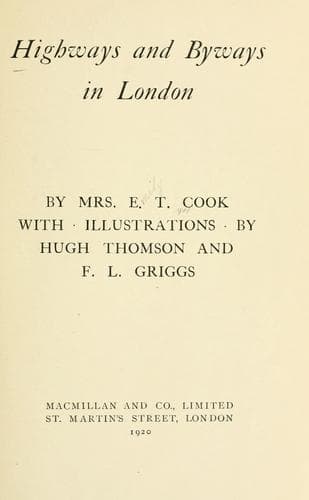
Highways and Byways in LondonCook, Emily Constance Baird
History
Highways and Byways in London
Cook, Emily Constance Baird
London (England) -- Description and travel
Close by Crosby Hall is the turning into Great St. Helen's; indeed,
the long windows of the hall back on to the square of that name. This
curious old convent church, set in its little secluded enclosure, has
been called "the Westminster Abbey of the City." It is certainly rich
in historical tombs and monuments. Originally founded in the 13th
century as the "Priory of St. Helen's for Nuns of the Benedictine
Order," its accessories have, like those of St. Bartholomew the Great,
been long removed and built over, and its cloisters exist no more. Yet
what remains of it is full of interest. It is comparatively very
unvisited. The last time I was there, I noticed one depressed
American, "doing" the tombs sadly. I felt for him, for though it was
only 3 o'clock on an October day, it was much too dark to read or see,
and he had evidently lost himself among the monuments. The sextoness,
who was apparently engaged in the careful brushing of her black silk
dress in the vestry, was much too superior to notice him. St. Helen's
is a dark church at any time; on this occasion a "London particular"
was also impending, and even the gold letters on Sir Thomas Gresham's
massive tomb scarcely showed in the fading light. But it was a
picturesque scene, despite the sad lack of "glory on the walls." The
old knights and ladies, motionless on their narrow beds, glimmered in
ghostly fashion, silent witnesses of the flight of the centuries. The
quaint, stiff effigies, clad in ruff and farthingale,--while they have
knelt there, how many generations, in the turbulent world outside,
have been born and died? Bancroft's unwieldy tomb is gone from its
old place; else you might well have imagined the shade of the
eccentric philanthropist stealing from it by night, pressing back its
careful hinges, and fumbling for the bread and wine that he had
ordered by will to be placed near by for his awakening. You mistook,
in the dim light, Sir John Spencer's kneeling heiress-daughter for a
guardian angel, and you were awed by the still, calm mediævalism of
the altar-tomb of the Crosbys.... It was all so vague and so misty
that the mind really seemed to participate in the general fog, and I
remember gazing vaguely on the words, "Julius Caesar,"--inscribed, in
enormous letters, on a sumptuous altar-tomb,--feeling that I fervently
sympathised with the royal lady who, when shown the magic name, is
said to have remarked naïvely:
"But I always thought that Julius Caesar was buried in Rome!"
Public-domain text, read in full here on John Shaqi.
Reviews
Reviews
No reviews yet
Be the first to share your thoughts on this work.
Elsewhere in the archive
Join the Discussion
Join the discussion
Sign in to leave a comment or review.
Sign InorCreate an account