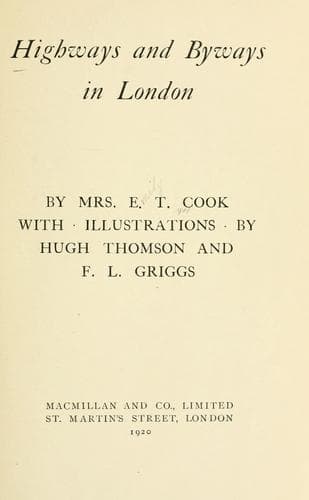
Highways and Byways in LondonCook, Emily Constance Baird
History
Highways and Byways in London
Cook, Emily Constance Baird
London (England) -- Description and travel
It is surely very unfair for individuals to perpetrate post-mortem
puzzles of the kind! For this "Julius Caesar," (who, by-the-way,
gained his false honours by dropping his surname) was merely a Judge
and a Master of the Rolls of Elizabeth's day, and, evidently, as shown
by his tomb, designed by himself, what is called "a crank" also. When
I had got over the "Julius Caesar" deception, I sympathised duly with
the large family of "John Robinson, alderman," whose children form a
long kneeling procession behind him; and still more did I mourn for
those unhappy nuns who, poor things, were immured in the darkness
behind "the Nuns' Grate," or "hagioscope"; their scant peepholes so
unkindly devised that they could only see the altar, and not the
congregation! These "Black Nuns" of St. Helen's must, nevertheless,
one thinks, have been often but naughty, giggling school-girls,
despite their show of conventual discipline. Perhaps, as Chaucer would
have us believe, such discipline was but lax in England in the middle
ages. Be that as it may, we find, at one time, no less authorities
than the Dean and Chapter of St. Paul's admonishing them thus:
"Also we enjoyne you, that all daunsyng and reveling be
utterly forborne among you, except at Christmasse, and other
honest tymys of recreacyone, among yourselfe usyd, in
absence of seculars in alle wyse."
Of the two aisles that form the church, the "Nuns' Aisle" is that to
the left as you enter, and the steps to their destroyed cloister (now
blocked up) open out of it. The little garden plot outside the church
is neatly kept, and on my last visit I noticed some gardeners putting
in a plentiful supply of bulbs for spring blooming. Doubtless, the
"Black Nuns" enjoyed among their other "recreacyones," a lovely and a
well-ordered convent garden outside their cloister; "cherry trees" are
specially mentioned in St. Helen's register; and, as we know, the
London of that day grew many luscious fruits.
Farther down Bishopsgate Street, is the tiny church of St. Ethelburga,
uninteresting as regards its interior, but one of the oldest existing
churches in London, and certainly the smallest. It escaped the ravages
of the Great Fire, and history mentions it as early as 1366. I passed
it three times without noticing it, for its little spirelet rises but
slightly above the roofs of the intervening shops, and its tiny
doorway, labelled itself like a small shop, is easily overlooked
between two projecting windows. (The smallness of the place can be
imagined from the fact that, only a few doors from it, no one can be
found to direct you to it.) The verger lives in a very picturesque and
overhanging slum-alley close by; though his abode suggests Fagin, he
is, nevertheless, an amiable and obliging gentleman.
Public-domain text, read in full here on John Shaqi.
Reviews
Reviews
No reviews yet
Be the first to share your thoughts on this work.
Elsewhere in the archive
Join the Discussion
Join the discussion
Sign in to leave a comment or review.
Sign InorCreate an account