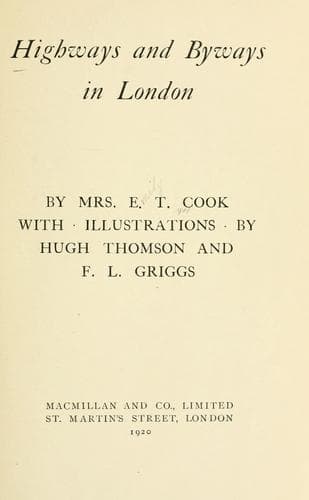
Highways and Byways in LondonCook, Emily Constance Baird
History
Highways and Byways in London
Cook, Emily Constance Baird
London (England) -- Description and travel
Just east of Bishopsgate is Houndsditch (its somewhat unpleasantly
suggestive name commemorating the ancient City moat), with, near by,
the Jewish quarter of St. Mary Axe, "Rag Fair," and Petticoat Lane
(now Middlesex Street), noted, like Brick Lane, Spitalfields, for its
Sunday morning markets. Why is the Jewish quarter so invariably
concerned with old clothes? As the rhyme says:
"Jews of St. Mary Axe, of jobs so wary
That for old clothes they'd even axe St. Mary."
Close by Houndsditch is Bevis Marks (Bury's Marks), now descended from
its ancient glories; it used to contain the City mansion, "fair courts
and garden plots," of the Abbots of Bury St. Edmunds, but now
principally recalls Dickens's unsavoury characters, Miss Sally Brass
and her brother Sampson (in _The Old Curiosity Shop_). Here, once
again, Dickens gets thoroughly the strange, semi-human spirit of
London slums and by-ways; it is in such places that his genius attains
its highest flights. That he was always, too, very careful as regarded
his details, is shown in a letter on this subject to his friend
Forster. He spent (he says), a whole morning in Bevis Marks,
selecting:
"the office window, with its threadbare green curtain all
awry; its sill just above the two steps which lead from the
side-walk to the office door, and so close on the footway
that the passenger who takes the wall brushes the dim glass
with his elbow."
It seems, however, almost too invidious to select special rambles.
For, the whole of this heart of the city,--except only for certain
well-defined "infernos" of modern industry and ugliness, such as the
great Liverpool-Street terminus, must be deeply interesting to every
Londoner and every Englishman. Even in comparatively dull streets,
lined with warehouses and offices, there will always be some little
oasis to rest and refresh the wanderer. Suppose that, instead of going
up Cornhill, you take another wheel-spoke from the Mansion-House; say
Lombard-Street, the home _par excellence_ of the bankers. This street
is solid and stately, as you would expect; the very name has a moneyed
ring about it! The derivation of the name, by-the-way, is curious; it
comes from Lombard bankers who appear to have settled here at an early
date; the street bore their name in the reign of Edward II. The square
tower, crowned by an octagonal spire, that rises on the north side of
Lombard Street, is that of the church of St. Edmund the King and
Martyr, in which was made poor Addison's not too happy marriage with
the Dowager Countess of Warwick and Holland. Still continuing east,
past Gracechurch Street, we come to Fenchurch Street, a thoroughfare
that runs parallel with the busy mart of Eastcheap, famed in
Shakespeare, and possibly no less dirty and noisy than it was in Dame
Quickly's time. Out of Fenchurch Street opens Mincing Lane, a name
that commemorates the "minchens" or nuns of St. Helen's; that convent
owned a great deal of property about here.
Public-domain text, read in full here on John Shaqi.
Reviews
Reviews
No reviews yet
Be the first to share your thoughts on this work.
Elsewhere in the archive
Join the Discussion
Join the discussion
Sign in to leave a comment or review.
Sign InorCreate an account