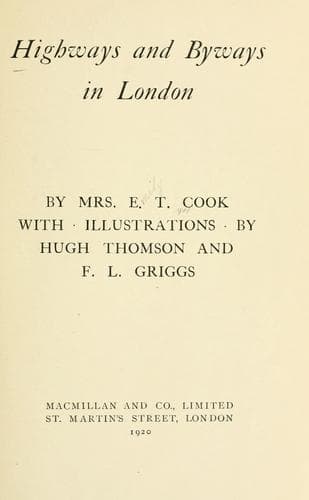
Highways and Byways in LondonCook, Emily Constance Baird
History
Highways and Byways in London
Cook, Emily Constance Baird
London (England) -- Description and travel
It is strange that London fires--and London, in the middle ages, was
specially prolific in fires--have never altered the course of the
city's highways. Sir Christopher Wren wished, indeed, after the Great
Fire of 1666, to be allowed to alter the plan of the desolated town
and make it more symmetrically regular: with all due admiration of his
genius, one cannot, however, help feeling a certain thankfulness that
destiny averted his schemes, and that in the prosaic London of our own
day we can still trace the splendour, the romance of its past. Thus,
even in the grimy city "courts" we can still imagine a Roman
"impluvium," or the ancient gardens of Plantagenet palaces; in the
blind alleys of "Little Britain," the splendours of the merchants'
mansions; in the ugly lines of mews and slums, the limits of the
vanished Norman convent closes. The boundaries are still there, though
nearly all else has gone. For, though Londoners are generally
conservative with regard to their chief sites and the lines of their
streets, they have, so far as their great buildings are concerned,
always been by nature iconoclastic. Not that we of the present day
need give ourselves any airs in this matter. Although, indeed, for the
last half-century the spirit of antiquarian veneration has been
abroad, yet the great majority of Londoners are hardly affected by it,
and the pulling down of ancient buildings continues almost as gaily as
ever at the present day. It may be said that we pull down for
utilitarian reasons; well, so did our forefathers; Londoners have
always been practical. Religious zeal may occasionally have served to
whet their destructive powers, but the results are pretty much the
same. Perhaps Henry VIII.--that Bluebeard head of the Church and
State--has, in his general dissolution of the monasteries and
alienation of their property, been the greatest iconoclast in English
annals; yet even he must have been nearly equalled by the Lord
Protector Cromwell, whose Puritanical train wrought so much havoc
among London's monuments of a later age. Reforms and improvements, all
through the world's history, have always been cruelly destructive.
For, while churches and palaces were destroyed as relics of Popery,
while works of art were demolished, and frescoes whitewashed in
reforming zeal, fresh life was always sprouting, fresh energy ever
filling up gaps, ever obliterating the traces of the past, the relics
of the older time. Sir Walter Besant, in his picturesque and vivid
sketch of English history, has realised well for us the city's past
life:--
Public-domain text, read in full here on John Shaqi.
Reviews
Reviews
No reviews yet
Be the first to share your thoughts on this work.
Join the Discussion
Join the discussion
Sign in to leave a comment or review.
Sign InorCreate an account