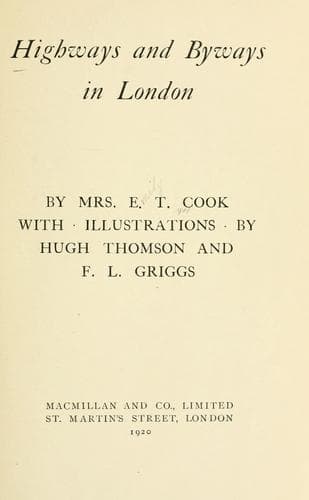
Highways and Byways in LondonCook, Emily Constance Baird
History
Highways and Byways in London
Cook, Emily Constance Baird
London (England) -- Description and travel
Between Tower Green and the outer moat, on the western side of the
gravelled square, are the old-fashioned and comfortable-looking
dwelling houses of the Tower officials; the residences of the
Governor, the doctor, the Chaplain, &c.; houses mainly of darkened
brick,--like the citadel itself,--fitted in between the "Beauchamp"
and the "Bell" towers. The greater part of the fortress is, as we have
seen, utilised as arsenal, barracks, or private dwellings; and thus,
of its many towers, the "White Tower," (the "Keep" of the ancient
castle), and the "Beauchamp Tower," are the only ones now viewed by
the general public; though other antiquities and places worthy of a
visit may, on application to the Governor, be shown to those "really
interested." The Beauchamp Tower, though "restored" in 1854 (when all
its inscriptions were placed together in one room), is still most
interesting. Certainly, the draughts, on a windy day, of that room, go
far to suggest the justice of my friend the warder's complaint. And
the poor prisoners of old days did not know the modern comfort of
"slow-combustion" stoves! Poor creatures! torn by the rack and
torture, crushed by long, hopeless imprisonment, with no friend to
turn to in their need, they have left us, deeply cut into the prison
walls, their most pathetic complaint. Philosophy, on the whole, seems
here to have been of the most availing comfort. Like Socrates, the
wretched victims tried hard to be stoical. "The most unhappie man in
the world," runs one inscription, "is he that is not pacient in
adversitie." Then, in old Norman-French: "Tout vient apoient, quy
peult attendre." "A passage perillus maketh a port pleasant." It was
here, in the Beauchamp Tower, that the five Dudley brothers, sons of
the Duke of Northumberland, were imprisoned for their share in the
Lady Jane Grey rebellion; here are their pictured emblems and
hieroglyphics; also the word "Jane," supposed to have been cut by her
husband, Lord Guildford. To the longer victims of the Tower, time must
have passed hardly. Was it agony of mind that guided the stroke, or
did they find it some solace in their anguish? Poets, philosophers,
men of science, all the best and noblest in the land; hours of solace
after torture, no doubt, were theirs, given by that good Angel who,
"Brought the wise and great of ancient days
To cheer the cell where Raleigh pined alone."
Had they books, journals, writing materials? Probably but rarely.
There was Raleigh, who spent such a large part of a chequered life in
prison here, dying here too at last, and writing his "History" with
admirable stoicism, in the face of death. But Lady Jane Grey,
imprisoned in the "Brick Tower," had, we know, to inscribe her last
message to her sister Katherine, on the blank leaves of her Greek
Testament. What vivid, what painful interest would attach to a "Tower"
diary, such as Pepys's, in cipher, could one have been written by any
of these prisoners!
Public-domain text, read in full here on John Shaqi.
Reviews
Reviews
No reviews yet
Be the first to share your thoughts on this work.
Elsewhere in the archive
Join the Discussion
Join the discussion
Sign in to leave a comment or review.
Sign InorCreate an account