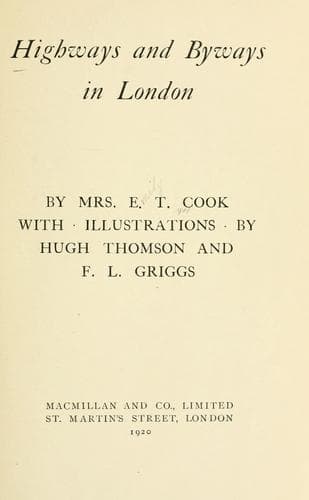
Highways and Byways in LondonCook, Emily Constance Baird
History
Highways and Byways in London
Cook, Emily Constance Baird
London (England) -- Description and travel
London Bridge is the terminus for big ships; from its parapet is seen,
as far as the misty Tower Bridge, a vast city of masts, sails, and
wharves. Big steamers often make this their starting-point for
excursions, and sails of Venetian colour charm the eye. In cold
winters the sea-gulls, flying hither in myriads from the icy North
Seas, come to the Londoner's call, sure of food and welcome, filling
grey sky and silvery river with an ever-changing constellation of
white wings; "a blaze of comet splendour." Wild birds, like children,
know their friends. The sea-gull's wide, downward swoop, so powerful
and so graceful, may be watched here in January from early morn to
dusk; the creatures, poised in serried ranks on the barges and stone
piers, are just as much at home here as on their own northern
pinnacles, and after long sojourn, they become so tame that they will
almost feed from the stranger's hand. It is only, however, during the
severe weather that the sea-gulls' visit lasts; with the first warm
February days they are off again, speeding down the river to their
native haunts.
Close to the foot of London Bridge, on the Southwark side, is the fine
cruciform church of St. Saviour's, lately restored on the lines of the
ancient edifice. This church, which had formerly been much mutilated
by careless and tasteless "restorers," was in long past times the
Norman Priory of St. Mary Overy, and its old nave, of which the
fragments may yet be seen, was built in 1106 by Gifford, Bishop of
Winchester. A century later, another Bishop built the choir and Lady
Chapel, and altered the character of the nave from Norman to Early
English. Then, at the Dissolution, St. Mary Overy was made into a
parish church by Henry VIII., and since 1540, it has been known as
"St. Saviour's." The early Saxon dedication to "St. Mary Overy"
commemorates the romantic story of the rich old ferryman's lovely
daughter, of pre-Conquest times, who, losing her lover by a fall from
his horse, retired into a cloister for life, devoting her paternal
wealth to the founding of a priory. The story is charming, but
somewhat misty; it suggests, however, the advantages accruing to
ferrymen when there were no bridges on the Thames! An ancient,
nameless, ghoul-like figure, in St. Saviour's Church, is still pointed
out as the old ferryman, father of the foundress; but this is probably
traditional. Skeleton-like figures, not representing any one in
particular, were not infrequently placed about in mediæval churches;
in order, perhaps, to bring the congregation to a sufficiently sober
frame of mind, as well as to recall to them their latter end.
Public-domain text, read in full here on John Shaqi.
Reviews
Reviews
No reviews yet
Be the first to share your thoughts on this work.
Elsewhere in the archive
Join the Discussion
Join the discussion
Sign in to leave a comment or review.
Sign InorCreate an account