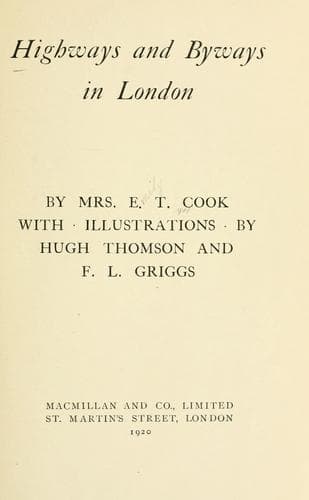
Highways and Byways in LondonCook, Emily Constance Baird
History
Highways and Byways in London
Cook, Emily Constance Baird
London (England) -- Description and travel
St. Saviour's, as it is now, is one of the most striking churches in
London; its interior appeals at once to the eye and to the
imagination. The long aisles are restful and harmonious; the
Early-English architecture is severely pure; the fine effect of the
beautifully-restored nave and transepts is not, as too often in
Westminster Abbey, spoiled by the introduction of ornate tombs and
sprawling angels. The church, restored by Blomfield in 1890-96, is
already a collegiate church, and is worthy to become, as it probably
will, the cathedral for South London. Its level, as is the case with
many ancient buildings, is now considerably lower than the surrounding
ground; a fact testified by the steps necessary to descend into its
precincts from the street, and by the very unpoetic railway, carried
well above it and its adjoining vegetable market (the Borough Market).
For this is a strangely busy and noisy spot to have sheltered for so
long this relic of the Middle Age.
The tombs in the church are mainly in the transepts, and are nearly
all of them interesting. The finely-restored "Lady Chapel," behind the
altar, contains the tomb of Lancelot Andrewes, Bishop of Winchester,
with a long Latin inscription of 1626; a recumbent painted effigy, on
a black-and-white marble tomb. This Lady Chapel has tragic
associations; it was used in the time of "Bloody Mary" as the
Consistorial Court of Gardiner, Bishop of Winchester; and here those
sturdy martyrs, Bishop Hooper and John Rogers, Vicar of St.
Sepulchre's, were condemned to be burnt (the popular feeling for
Rogers being such as necessitated his removal by night secretly to
Newgate).
The most famous grave in St. Saviour's is that of John Gower, the
fourteenth-century poet, and friend of Chaucer. Here, near the east
end of the north wall of the nave, the effigy of the poet, painted,
like that of Lancelot Andrewes, a figure of striking beauty, lies on a
sarcophagus under a rich gabled canopy. Stow thus describes the
monument:
"He lieth under a tomb of stone, with his image, also of
stone, over him; the hair of his head, auburn, long to his
shoulders but curling up, and a small forked beard; on his
head a chaplet like a coronet of four roses; a habit of
purple, damasked down to his feet; a collar of esses gold
about his neck; under his head the likeness of three books
which he compiled."
Gower was a rich man for a poet, and gave large sums in his time for
the rebuilding of the church; hence was written the following epigram:
"This church was rebuilt by John Gower, the rhymer,
Who in Richard's gay court was a fortunate climber;
Should any one start, 'tis but right he should know it,
Our wight was a lawyer as well as a poet."
Gower's three chief works, on which his head rests, are his _Vox
Clamantis_, _Speculum Meditantis_, and _Confessio Amantis_.
Public-domain text, read in full here on John Shaqi.
Reviews
Reviews
No reviews yet
Be the first to share your thoughts on this work.
Elsewhere in the archive
Join the Discussion
Join the discussion
Sign in to leave a comment or review.
Sign InorCreate an account