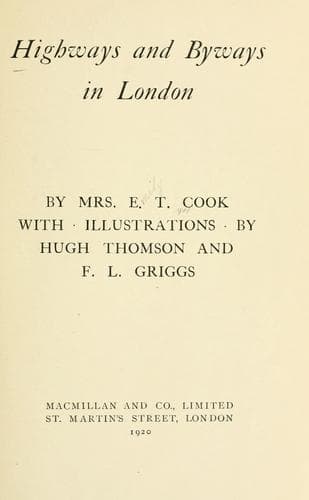
Highways and Byways in LondonCook, Emily Constance Baird
History
Highways and Byways in London
Cook, Emily Constance Baird
London (England) -- Description and travel
The church is now well-kept and carefully tended; it is open daily to
the visitor, who may walk about it without let or hindrance. Like so
many other London churches, it has in its time suffered less from the
depredations of the plunderer than from those of the more dangerous
"restorer." As usual, a long period of neglect and decay was followed
by iconoclastic cleaning and setting in order. Generally, for a
considerable time after the Dissolution, the convent churches and
others were left to the tender mercies of the parishioners, who,
naturally, could not always afford to keep them in proper condition;
then abuses crept in, thefts took place; and the disused churches, as
St. Paul's itself, were often degraded to stables, or used as storage
for litter. Then, after long years, the authorities, perhaps, came to
the rescue, and, turning out the encroaching and invading devils, let
in other devils far more wicked, in the shape of so-called
"restorers." Wonder, indeed, is it that so much is left to us! The
"restorers" usually began by whitewashing all the columns of dark
Purbeck marble, blackening the effigies into one uniform tint, and
covering the discoloured carvings of the walls with stucco, for the
better reception of which they even (as may be seen at St. Saviour's)
whittled away bits of fine stone sculpture.
To wander down the "Borough" High Street--that noisy and essentially
modern district,--in search of Chaucer's famous inns, is, alas! more
dispiriting than looking for traces of Dido among the ruins of
Carthage. Here, one can neither look for ghosts, nor feelings of the
past; all is hopelessly covered up and hidden by ugly modern inns,
more ugly modern shops, palaces of modern plate-glass public-houses,
triumphs of early nineteenth-century ugliness in architecture. What
chance, among such, have the poor wandering ghosts of a famous past?
And, since London Bridge, that natural dividing-line of peoples, was
passed, have not the very streets changed in some subtle and
unconscious manner, to a more sordid character; the shops to a more
blatant kind,--even the people to a different and lower type? It may
be partly fancy; yet, is not this often the effect produced by the
"Surrey side"? The big thoroughfare called the Borough High Street, or
more simply, the "Borough"--(this part of Southwark has fairly earned
the right to be called the "Borough," having returned two members to
Parliament for 500 years),--this was the great highway, even in Roman
times, between the city and the southern counties. East of the
Borough, the long, narrow, busy, dirty Tooley Street leads to
Bermondsey; this street is famous for its "three tailors" of the
political legend, according to which they addressed the House of
Commons as "We, the People of England." Here, from mediæval days, was
the only bridge; here, therefore, were, naturally, stationed all the
mediæval inns and hostelries. This way did the "Canterbury Pilgrims"
Public-domain text, read in full here on John Shaqi.
Reviews
Reviews
No reviews yet
Be the first to share your thoughts on this work.
Elsewhere in the archive
Join the Discussion
Join the discussion
Sign in to leave a comment or review.
Sign InorCreate an account