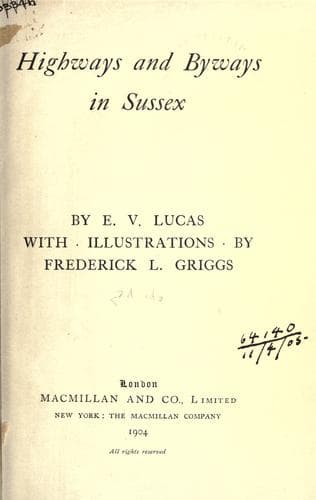
Highways and Byways in SussexLucas, E. V. (Edward Verrall)
History
Highways and Byways in Sussex
Lucas, E. V. (Edward Verrall)
Sussex (England) -- Description and travel
Sussex abounds in evidences of the Devil's whimsical handiwork, although
in ordinary conversation Sussex rustics are careful not to speak his
name. They say "he." Mr. Parish, in his _Dictionary of the Sussex
Dialect_, gives an example of the avoidance of the dread name: "'In the
Down there's a golden calf buried; people know very well where it is--I
could show you the place any day.' 'Then why don't they dig it up? 'Oh,
it's not allowed: _he_ wouldn't let them.' 'Has any one ever tried?' 'Oh
yes, but it's never there when you look; _he_ moves it away.'" His
punchbowl may be seen here, his footprints there; but the greatest of
his enterprises was certainly the Dyke. His purpose was to submerge or
silence the irritating churches of the Weald, by digging a ditch that
should let in the sea. He began one night from the North side, at
Saddlescombe, and was working very well until he caught sight of the
beams of a candle which an old woman had placed in her window. Being a
Devil of Sussex rather than of Miltonic invention, he was not clever,
and taking the candle light for the break of dawn, he fled and never
resumed the labour. That is the very infirm legend that is told and sold
at the Dyke.
[Sidenote: HANGLETON]
I might just mention that the little church which one sees from the Dyke
railway, standing alone on the hill side, is Hangleton. Dr. Kenealy, who
defended the Claimant, is buried there. The hamlet of Hangleton, which
may be seen in the distance below, once possessed a hunting lodge of the
Coverts of Slaugham, which, after being used as labourers' cottages, has
now disappeared. The fine Tudor mansion of the Bellinghams', now
transformed into a farm house, although it has been much altered, still
retains many original features. In the kitchen, no doubt once the hall,
on an oak screen, are carved the Commandments, followed by this
ingenious motto, an exercise on the letter E:
Persevere, ye perfect men,
Ever keep these precepts ten.
[Illustration: _Hangleton House._]
From the Dyke hill one is within easy walking distance of many Wealden
villages. Immediately at the north end of the Dyke itself is Poynings,
with its fine grey cruciform church raising an embattled tower among
the trees on its mound. It has been conjectured from the similarity of
this beautiful church to that of Alfriston that they may have had the
same architect. Poynings (now called Punnings) was of importance in
Norman times, and was the seat of William FitzRainalt, whose descendants
afterwards took the name of de Ponyngs and one of whom was ennobled as
Baron de Ponyngs. In the fifteenth century the direct line was merged
into that of Percy. The ruins of Ponyngs Place, the baronial mansion,
are still traceable.
Public-domain text, read in full here on John Shaqi.
Reviews
Reviews
No reviews yet
Be the first to share your thoughts on this work.
Elsewhere in the archive
Join the Discussion
Join the discussion
Sign in to leave a comment or review.
Sign InorCreate an account