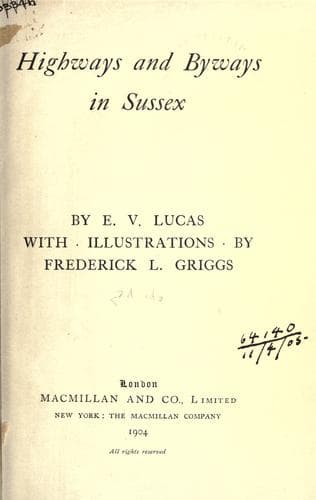
Highways and Byways in SussexLucas, E. V. (Edward Verrall)
History
Highways and Byways in Sussex
Lucas, E. V. (Edward Verrall)
Sussex (England) -- Description and travel
Following the road to the west, under the hills, we come first to
Fulking (where one may drink at a fountain raised by a brewer to the
glory of God and in honour of John Ruskin), then to Edburton (where the
leaden font, one of three in Sussex, should be noted), then to Truleigh,
all little farming hamlets shadowed by the Downs, and so to Beeding and
Bramber, or, striking south, to Shoreham.
[Sidenote: NEWTIMBER]
If, instead of turning into Poynings, one ascends the hill on the other
side of the stream, a climb of some minutes, with a natural amphitheatre
on the right, brings one to the wooded northern escarpment of
Saddlescombe North Hill, or Newtimber Hill, which offers a view little
inferior to that of the Dyke. At Saddlescombe, by the way, lives one of
the most learned Sussex ornithologists of the day, and a writer upon the
natural history of the county (so cavalierly treated in this book!), for
whose quick eye and descriptive hand the readers of _Blackwood_ have
reason to be grateful. Immediately beneath Newtimber Hill lies
Newtimber, consisting of a house or two, a moated grange, and a little
church, which, though only a few yards from the London road, is so
hidden that it might be miles from everywhere. On the grass bank of the
bostel descending through the hanger to Newtimber, I counted on one
spring afternoon as many as a dozen adders basking in the sun. We are
here, though so near Brighton, in country where the badger is still
found, while the Newtimber woods are famous among collectors of moths.
[Sidenote: PYECOMBE CROOKS]
If you are for the Weald it is by this bostel that you should descend,
but if still for the Downs turn to the east along the summit, and you
will come to Pyecombe, a straggling village on each side of the London
road just at the head of Dale Hill. Pyecombe has lost its ancient fame
as the home of the best shepherds' crooks, but the Pyecombe crook for
many years was unapproached. The industry has left Sussex: crooks are
now made in the north of England and sold over shop counters. I say
"industry" wrongly, for what was truly an industry for a Pyecombe
blacksmith is a mere detail in an iron factory, since the number of
shepherds does not increase and one crook will serve a lifetime and
more. An old shepherd at Pyecombe, talking confidentially on the subject
of crooks, complained that the new weapon as sold at Lewes, although
nominally on the Pyecombe pattern, is a "numb thing." The chief reason
which he gave was that the maker was out of touch with the man who was
to use it. His own crook (like that of Richard Jefferies' shepherd
friend) had been fashioned from the barrel of an old muzzle-loader. The
present generation, he added, is forgetting how to make everything: why,
he had neighbours, smart young fellows, too, who could not even make
their own clothes.
Public-domain text, read in full here on John Shaqi.
Reviews
Reviews
No reviews yet
Be the first to share your thoughts on this work.
Elsewhere in the archive
Join the Discussion
Join the discussion
Sign in to leave a comment or review.
Sign InorCreate an account