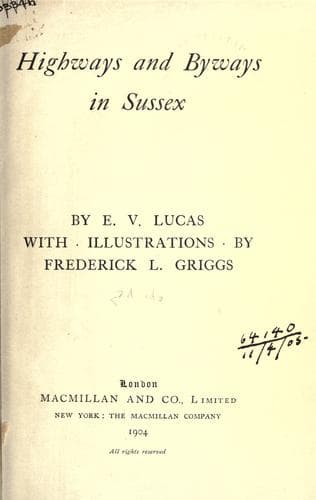
Highways and Byways in SussexLucas, E. V. (Edward Verrall)
History
Highways and Byways in Sussex
Lucas, E. V. (Edward Verrall)
Sussex (England) -- Description and travel
Pyecombe is but a few miles from Brighton, which may easily be reached
from it. A short distance south of the village is the Plough Inn, the
point at which the two roads to London--that by way of Clayton Hill,
Friar's Oak, Cuckfield, Balcombe and Redhill, and the other (on which we
are now standing) by way of Dale Hill, Bolney, Hand Cross, Crawley and
Reigate--become one.
On the way to Brighton from the Plough one passes through Patcham, a
dusty village that for many years has seen too many bicycles, and now is
in the way of seeing too many motor cars. In the churchyard is, or was,
a tomb bearing the following inscription, which may be quoted both as a
reminder of the more stirring experiences to which the Patcham people
were subject a hundred years ago, and also as an example of the truth
which is only half a truth:
[Sidenote: SMUGGLER AND EXEMPLAR]
Sacred to the memory of Daniel Scales, who was unfortunately shot
on Thursday Evening, Nov. 7, 1796.
Alas! swift flew the fatal lead
Which pierced through the young man's head,
He instant fell, resigned his breath,
And closed his languid eyes in death.
All ye who do this stone draw near,
Oh! pray let fall the pitying tear.
From the sad instance may we all
Prepare to meet Jehovah's call.
The facts of the case bear some likeness to the death of Mr. Bardell and
Serjeant Buzfuz's reference to that catastrophe. Daniel Scales was a
desperate smuggler who, when the fatal lead pierced him, was heavily
laden with booty. He was shot through the head only as a means of
preventing a similar fate befalling his slayer.
Just beyond Patcham, as we approach Brighton, is the narrow chalk lane
on the left which leads to the Lady's Mile, the beginning of a superb
stretch of turf around an amphitheatre in the hills by which one may
gallop all the way to the Clayton mills. The grass ride extends to
Lewes.
Preston, once a village with an independent life, is now Brighton; but
nothing can harm its little English church, noticeable for a fresco of
the murder of Thomas à Becket, a representation dating probably from the
reign of Edward I.
This, however, is a digression, and we must return to Pyecombe in order
to climb Wolstonbury--the most mountainous of the hills in this part,
and indeed, although far from the highest, perhaps the noblest in mien
of the whole range, by virtue of its isolation and its conical shape.
The earthworks on Wolstonbury, although supposed to be of Celtic origin,
were probably utilised by the Romans for military purposes. More than
any of the Downs does Wolstonbury bring before one the Roman occupation
of our country.
[Sidenote: DANNY]
Public-domain text, read in full here on John Shaqi.
Reviews
Reviews
No reviews yet
Be the first to share your thoughts on this work.
Elsewhere in the archive
Join the Discussion
Join the discussion
Sign in to leave a comment or review.
Sign InorCreate an account