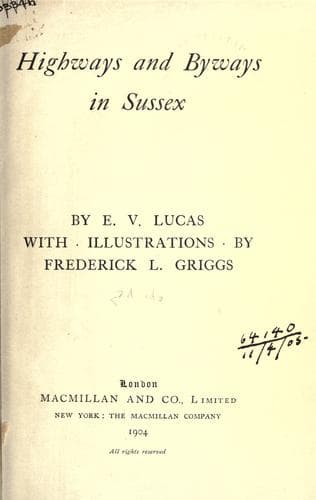
Highways and Byways in SussexLucas, E. V. (Edward Verrall)
History
Highways and Byways in Sussex
Lucas, E. V. (Edward Verrall)
Sussex (England) -- Description and travel
The next station on this quiet little cross-country line to Lewes, is
Sheffield Park, the seat of Lord Sheffield. The present peer, one of the
patrons of modern Sussex cricket, took a famous team to Australia in
1891-2, and it was on his yacht that in 1894 cricket was played in the
Ice Fiord at Spitzbergen under the midnight sun, when Alfred Shaw
captured forty wickets in less than three-quarters of an hour.
Australian teams visiting England used to open their season with a match
at Sheffield Park, which contains one of the best private grounds in the
country; but the old custom has, I fancy, lapsed. In the long winter of
1890-1 several cricket matches on the ice were played on one of the
lakes in the park, with well-known Sussex players on both sides.
Sheffield Park is associated in literature with the name of Edward
Gibbon, the historian, who spent much time there in the company of his
friend, John Baker Holroyd, the first earl. Gibbon's remains lie in
Fletching church, close by. There also lies Peter Dynot, a glover of
Fletching, who assisted Jack Cade, the Sussex rebel, whom we meet later,
in 1450; while (more history) it was in the woods around Fletching
church that Simon de Montfort encamped before he climbed the hills, as
we are about to see, and fought and won the Battle of Lewes, in 1264.
The line passes next between Newick, on the east, and Chailey on the
west. Fate seems to have decided that these villages shall always be
bracketed in men's minds, like Beaumont and Fletcher, or Winchelsea and
Rye: one certainly more often hears of "Newick and Chailey" than of
either separately. Chailey has a wide breezy common from which the line
of Downs between Ditchling Beacon and Lewes can be seen perhaps to their
best advantage. Immediately to the south, and just to the west of
Blackcap, the hill with a crest of trees, is Plumpton Plain, six hundred
feet high, where the Barons formed their ranks to meet the third Harry
in the Battle of Lewes, the actual fighting being on Mount Harry, the
hill on Blackcap's east. A cross to mark the struggle, cut into the turf
of the Plain, is still occasionally visible. More noticeable is the "V"
in spruce firs planted on the escarpment to commemorate the Jubilee of
1887.
[Sidenote: THE SHEPHERD MATHEMATICIAN]
Public-domain text, read in full here on John Shaqi.
Reviews
Reviews
No reviews yet
Be the first to share your thoughts on this work.
Elsewhere in the archive
Join the Discussion
Join the discussion
Sign in to leave a comment or review.
Sign InorCreate an account