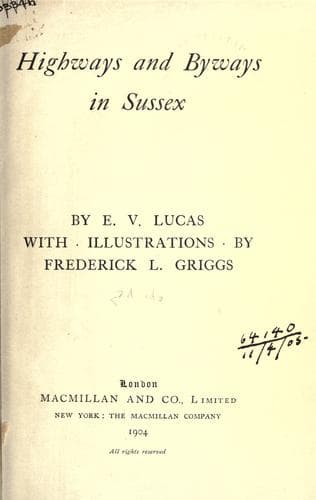
Highways and Byways in SussexLucas, E. V. (Edward Verrall)
History
Highways and Byways in Sussex
Lucas, E. V. (Edward Verrall)
Sussex (England) -- Description and travel
Plumpton, which is now known chiefly for its steeplechases, has had in
its day at least two interesting inhabitants. One was John Dudeney,
shepherd, mathematician, and schoolmaster, born here in 1782, who, as a
youth, when tending his sheep on Newmarket Hill, dug a study and library
in the chalk, and there kept his books and papers. He taught himself
mathematics and languages, even Hebrew, and ultimately became a
schoolmaster at Lewes. In his thorough adherence to learning Dudeney was
the completest contrast to John Kimber of Chailey, a wealthy farmer with
a consuming but unintelligent love of books, who was once, says
Horsfield, seen bringing home Macklin's Bible, a costly work in six
volumes in a sack laid across the back of a cart horse. According to the
excellent habit of the old Sussex farmers, Mr. Kimber's body was borne
to the grave in one of his wagons, drawn by his best team.
[Sidenote: FANTASTIC FRUITS]
Plumpton Place once had a moat, in which, legend has it, the first carp
swam that came into England. The house then belonged to Leonard Mascall,
whom Fuller in the _Worthies_ erroneously ascribes to Plumsted. In
Fuller's own words, which no one could better: "Leonard Mascall, of
Plumsted in this county, being much delighted in Gardening, man's
Original vocation, was the first who brought over into England, from
beyond the seas, _Carps_ and _Pippins_; the one, well-cook'd, delicious,
the other cordial and restorative. For the proof hereof, we have his own
word and witness; and did it, it seems, about the Fifth year of the
reign of King _Henry_ the Eighth, Anno Dom. 1514. The time of his death
is to me unknown." The credit of introducing carps and pippins has,
however, been denied to Mascall, who died in 1589 at Farnham Royal in
Buckinghamshire, where he was buried; but we know him beyond question to
have been an ingenious experimentalist in horticulture. He wrote and
translated several books, among them a treatise on the orchard by a monk
of the Abbey of St. Vincent in France: _A Book of the Arte of and Manner
howe to plant and graffe all sortes of trees, howe to set stones, and
sowe Pepines to make wylde trees to graffe on_, 1572. I take a few
passages from a later edition of this work:
TO COLOUR APPLES.
To have coloured Apples with what colour ye shall think good ye shall
bore or slope a hole with an Auger in the biggest part of the body of
the tree, unto the midst thereof, or thereabouts, and then look what
colour ye will have them of. First ye shall take water and mingle your
colour therewith, then stop it up again with a short pin made of the
same wood or tree, then wax it round about. Ye may mingle with the said
colour what spice ye list, to make them taste thereafter. Thus may ye
change the colour and taste of any Apple.... This must be done before
the Spring do come....
TO MAKE APPLES FALL FROM THE TREE.
Public-domain text, read in full here on John Shaqi.
Reviews
Reviews
No reviews yet
Be the first to share your thoughts on this work.
Elsewhere in the archive
Join the Discussion
Join the discussion
Sign in to leave a comment or review.
Sign InorCreate an account